诸
Character Story & Explanation
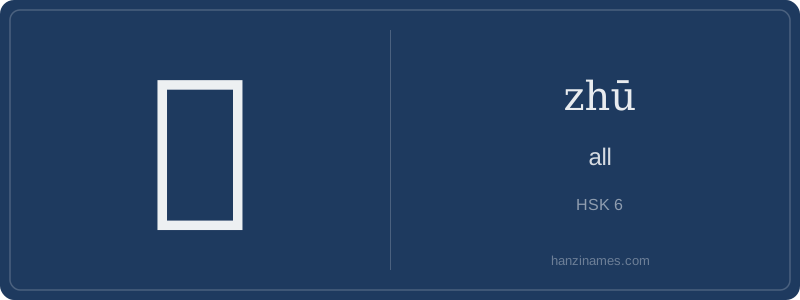
诸 is widely used in formal written Chinese—especially in idioms, official notices, and scholarly writing. Common phrases include 诸位 (zhūwèi, 'everyone' — respectful address), 诸多 (zhūduō, 'numerous'), and 诸如此类 (zhūrúcǐlèi, 'and so forth'). Historically, it appeared in pre-Qin texts like the *Zuo Zhuan*, often introducing lists of states or officials (e.g., 诸侯, 'feudal lords'). Modern media use it for concision: headlines like '诸多问题亟待解决' ('Numerous problems urgently need resolution') rely on its compact, authoritative tone.
The character evolved from seal script: its right component 者 was originally a pictograph of an old man with a torch (indicating 'one who illuminates' → 'that which is indicated'), later abstracted. The left 讠 (speech radical) signals linguistic function—marking 诸 as a discourse particle, not a concrete noun. Today, Chinese people encounter it daily in news headlines, university notices, and formal speeches—never in casual WeChat messages, but always where precision and decorum matter.
The Chinese character 诸 (zhū) is a classical and formal quantifier meaning 'all', 'various', or 'numerous'. Unlike English's simple 'all', 诸 carries a literary, almost ceremonial weight—common in set phrases, official documents, and idioms. It rarely stands alone; instead, it prefixes nouns to convey collective scope: 诸侯 (zhūhóu, 'feudal lords'), 诸多 (zhūduō, 'numerous'). Its usage signals elevated diction, much like Latin-derived terms in English (e.g., 'aforementioned' vs. 'said').
Etymologically, 诸 combines the speech radical 讠 (yán, indicating language or utterance) with 者 (zhě, an archaic nominalizer meaning 'one who/that which'). Together, they originally signified 'those who speak' or 'the aforementioned ones'—evolving into a generalized plural marker. This reflects Classical Chinese’s reliance on context and grammatical particles rather than inflection, contrasting sharply with Indo-European syntax.
In modern Mandarin, 诸 retains its formal register but appears frequently in fixed expressions rather than spontaneous speech. Its cultural resonance mirrors Western rhetorical devices like 'the aforementioned', 'afore-cited', or legal Latin plurals ('inter alia'). Like these, 诸 adds precision and gravitas—not just quantity, but *intentional, inclusive totality*. Learners should treat it as a stylistic marker: using it casually risks sounding stilted, yet mastering it unlocks nuance in academic, journalistic, and historical texts.
Example Sentences
Common Compounds
Similar Characters — Don't Mix These Up
Your First Step into Chinese Culture: Get a Chinese Name
Every journey into Chinese begins with a name. Use our free Chinese name generator to create a meaningful, personalized Chinese name that fits you perfectly.
Get My Chinese Name →