谋
Character Story & Explanation
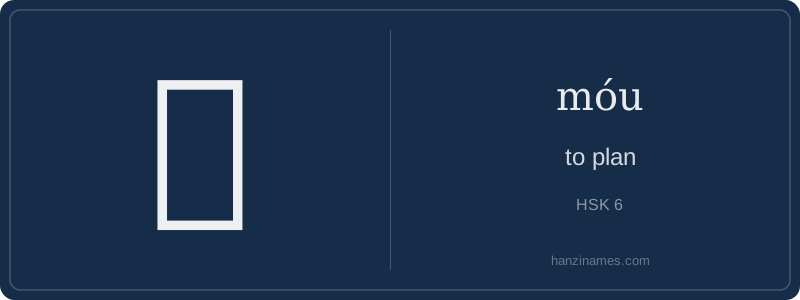
谋 is deeply embedded in classical and modern Chinese discourse. It appears in foundational texts like Sun Tzu’s The Art of War (c. 5th century BCE), where '谋攻' (móu gōng, 'planning for attack') opens Chapter 3—highlighting strategy over brute force. Today, it features in official language (e.g., '谋发展' móu fāzhǎn, 'plan for development') and common idioms like '出谋划策' (chū móu huà cè, 'offer plans and strategies'), used to praise advisors in business or government settings.
The character’s form evolved from seal script: left side 讠 (speech radical) + right side 莫 (mò, 'dusk'—phonetic component, later simplified). No pictographic origin exists; it’s a phono-semantic compound. Modern usage is overwhelmingly verbal and abstract—e.g., job seekers say '为前途谋出路' (wèi qiántú móu chūlù, 'plan an exit path for their future'), reflecting pragmatic, socially conscious planning.
The Chinese character 谋 (móu) conveys deliberate, strategic planning—often with intentionality, foresight, and sometimes moral ambiguity. Unlike English 'plan', which is neutral and ubiquitous (e.g., 'plan a picnic'), 谋 carries weight: it implies calculation, purpose, and frequently involves human agency in complex social or political contexts—like plotting a business strategy or devising state policy. Its radical 讠 (speech) signals that such planning is articulated, discussed, or negotiated—not merely mental.
Western equivalents like 'scheme', 'contrive', or 'conspire' capture its intensity but overemphasize negativity; 'plot' shares its narrative gravity yet lacks 谋’s institutional legitimacy. In Confucian thought, 谋 appears in ethical frameworks—for instance, the Analects urges '谋事以忠' ('plan affairs with loyalty'), framing planning as a moral duty. Thus, 谋 is neither inherently good nor evil—it’s defined by context, intent, and alignment with virtue.
This duality reflects a broader East Asian philosophical stance: action arises from deliberative speech and relational responsibility, not isolated rationality. While Western planning often emphasizes efficiency or individual goals, 谋 embeds planning within hierarchy, harmony, and accountability—to others, to tradition, to outcomes. That’s why idioms like '阴谋诡计' (yīnmóu guǐjì, 'secret schemes and deceitful tricks') coexist with '运筹帷幄' (yùnchóu wéiwò, 'plan strategically from behind the curtain')—both use 谋, yet one condemns and the other venerates the same act.
Example Sentences
Common Compounds
Similar Characters — Don't Mix These Up
Your First Step into Chinese Culture: Get a Chinese Name
Every journey into Chinese begins with a name. Use our free Chinese name generator to create a meaningful, personalized Chinese name that fits you perfectly.
Get My Chinese Name →