谬
Character Story & Explanation
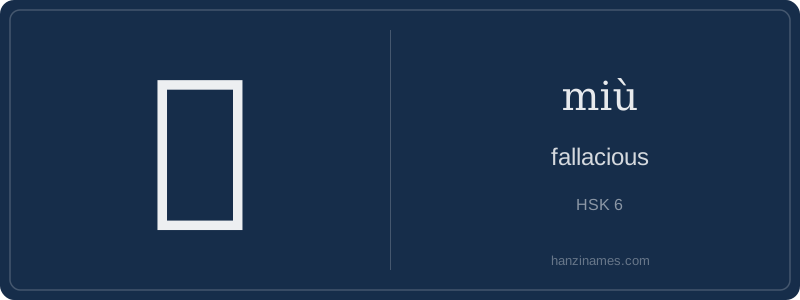
谬 is rarely used alone in daily speech; it appears almost exclusively in compound words and formal writing. It features prominently in classical and modern critical discourse — for example, in Mao Zedong’s 1942 *Talks at the Yan’an Forum on Literature and Art*, where he warns against ‘bourgeois idealism and its absurd theories’ (资产阶级唯心论及其谬论). It also appears in the idiom ‘谬以千里’ (miù yǐ qiān lǐ), from the *Han Shu*, meaning ‘a tiny error leads to a thousand miles of deviation’ — a cornerstone phrase in Chinese pedagogy about precision.
The character’s written form has no pictographic origin. It’s a standardized phono-semantic compound: 讠 (speech) + 瞫 (phonetic, historically related to ‘to look askance’, suggesting distorted perception). Today, Chinese students encounter it most often in essay feedback — e.g., a teacher writing ‘此处有谬’ (‘There’s an erroneous claim here’) in academic papers.
As a linguistic detective, I begin with the modern form of 谬: a left–right structure with 讠 (speech radical) and 瞫 (liù, phonetic component). Its 13 strokes encode a semantic truth — errors are not silent; they emerge from speech or discourse. The radical 讠 signals that the 'falsehood' is verbal, conceptual, or argumentative, not merely visual or physical — aligning precisely with its HSK 6 usage in academic, philosophical, and critical contexts.
Historically, 谬 evolved from the older character 謬 (with 言 instead of 讠), first attested in Han dynasty texts like the *Shuowen Jiezi* (121 CE), where it was defined as 'disordered speech' or 'words contradicting principle'. Unlike pictographic characters, 谬 is phono-semantic: 瞫 provides pronunciation (miù/liù), while 讠 anchors meaning. There’s no oracle bone or bronze script evidence — it entered standard usage during classical prose consolidation.
The character’s enduring power lies in its precision: it doesn’t mean trivial 'mistake' (错) or 'lie' (谎), but a systemic, logical, or doctrinal error — one that undermines truth itself. In modern Chinese, it appears almost exclusively in formal registers: critiques of ideology, scientific rebuttals, or literary analysis. This semantic gravity explains why it’s reserved for HSK 6: learners must grasp nuance, register, and philosophical weight — not just vocabulary.
Example Sentences
Common Compounds
Similar Characters — Don't Mix These Up
Your First Step into Chinese Culture: Get a Chinese Name
Every journey into Chinese begins with a name. Use our free Chinese name generator to create a meaningful, personalized Chinese name that fits you perfectly.
Get My Chinese Name →