譬
Character Story & Explanation
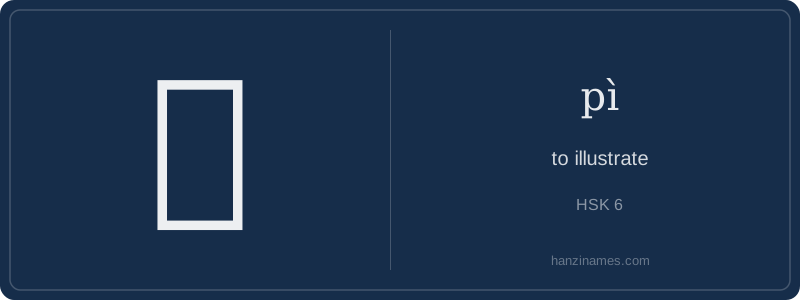
譬 is predominantly literary and formal—rare in spoken Mandarin but vital in classical exegesis, academic writing, and HSK-6-level reading. It appears in idioms like 譬如 (pìrú, 'for example'), one of the most common exemplifying phrases in formal Chinese, documented since the Han dynasty in texts like the Shuōwén Jiězì. Modern usage includes legal documents, philosophical essays, and standardized tests where precise logical illustration is required.
The character’s structure is clearly semantic-phonetic: 言 (speech radical) + 辟 (bì/pì, phonetic component, also meaning 'to avoid' or 'to open'). No oracle bone or bronze script form exists—it first appears in seal script (c. 3rd century BCE). Today, learners encounter it most often in HSK 6 reading passages or when parsing classical allusions in news editorials or university lectures.
Unearthing 譬 feels like brushing dust from a Han dynasty bamboo slip—its form reveals a deliberate, rhetorical act. The left side, 言 (yán), is the ‘speech’ radical, anchoring it firmly in discourse and persuasion. The right side, 辟 (bì/pì), originally meant ‘to open up’ or ‘to avoid’, but in this compound, it phonetically supports pronunciation while subtly evoking ‘clarification through opening a path’. This duality—speech + opening—captures how analogies illuminate meaning by clearing conceptual obstacles.
Archaeological inscriptions show 譬 rarely appeared in oracle bones or bronze scripts; it emerged later, in Warring States philosophical texts, where masters like Mencius deployed it to bridge abstract ethics and lived experience. Its 20 strokes reflect careful construction—not ornamentation, but precision: every stroke serves logic. The horizontal stroke across 辟’s top, for instance, transforms ‘opening’ into ‘structured illustration’, signaling that examples are not casual but methodical tools of reasoning.
Unlike pictographic characters rooted in concrete objects, 譬 is a late-blooming semantic-phonetic compound—evidence of Chinese writing maturing alongside philosophy. Its rarity in early corpora underscores its specialized function: not naming things, but framing thought. When excavated from classical commentaries, 譬 often appears mid-sentence, introducing similes that make Daoist paradoxes or Confucian duties graspable. It’s less a word than a cognitive lever—one that ancient scholars wielded to lift understanding from the literal into the luminous.
Example Sentences
Common Compounds
Similar Characters — Don't Mix These Up
Your First Step into Chinese Culture: Get a Chinese Name
Every journey into Chinese begins with a name. Use our free Chinese name generator to create a meaningful, personalized Chinese name that fits you perfectly.
Get My Chinese Name →