赁
Character Story & Explanation
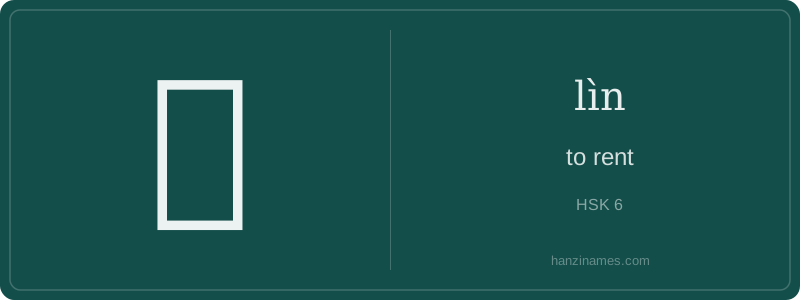
赁 is primarily used in formal, legal, and administrative contexts in contemporary Chinese. It appears in standardized terms like 租赁合同 (zūlìn hétong, 'lease agreement'), widely required by China’s Ministry of Housing and Urban-Rural Development. The character is also embedded in national policy documents—for example, the 2021 ‘Guidelines on Regulating Housing Rental Markets’ issued by six ministries consistently uses 租赁 to denote regulated residential leasing. It rarely appears in spoken Mandarin outside professional settings.
The character’s written form originates from the ancient ‘shell money’ radical 贝 (bèi), reflecting its monetary nature, combined with 冘 (yín), a phonetic component. Archaeological evidence confirms 贝-based characters were standardized during the Qin dynasty (3rd c. BCE) to denote financial transactions. No oracle bone or bronze script forms of 赁 survive, but its structure has remained stable since the Han dynasty clerical script.
The Chinese character 赁 (lìn) means 'to rent'—specifically, to temporarily pay for the use of property, vehicles, or services. Unlike English’s broad 'rent', 赁 carries a formal, transactional nuance and is rarely used in casual speech; it appears more often in contracts, legal documents, and official announcements. Its tone (fourth) and retroflex initial (l-) make pronunciation distinct for English speakers—think 'lin' with a sharp downward pitch.
Compared to Western rental concepts, 赁 reflects China’s historically strong distinction between ownership (ownership rights are deeply valued) and usage rights. In traditional Chinese society, leasing land or dwellings was common among tenant farmers and urban shopkeepers—but always framed as a time-bound, fee-based privilege, not a consumer service. This aligns with Confucian emphasis on stability and proper hierarchy in economic relationships.
In modern China, 赁 is less colloquial than 租 (zū), which dominates daily speech (e.g., 租房 ‘rent a house’). 赁 appears mainly in formal compounds like 租赁 (zūlìn, ‘lease’) and government-issued documents. Western equivalents like ‘lease’, ‘charter’, or ‘hire’ only partially match—it’s narrower than ‘rent’, more binding than ‘borrow’, and never implies reciprocity or gifting, unlike some Indigenous or communal sharing practices found globally.
Example Sentences
Common Compounds
Similar Characters — Don't Mix These Up
Your First Step into Chinese Culture: Get a Chinese Name
Every journey into Chinese begins with a name. Use our free Chinese name generator to create a meaningful, personalized Chinese name that fits you perfectly.
Get My Chinese Name →