赋
Character Story & Explanation
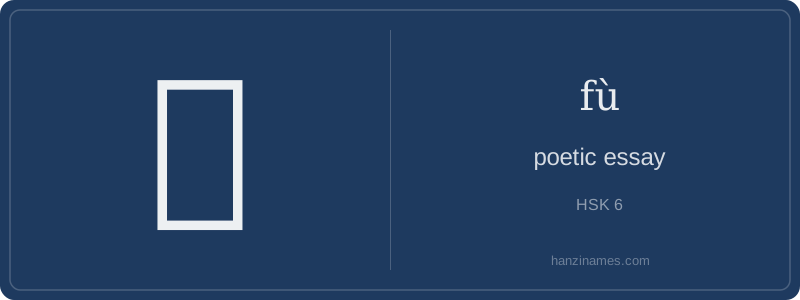
Historically, 赋 was one of the six major literary genres in imperial China, formalized during the Han Dynasty (206 BCE–220 CE). It appears in anthologies like the Wen Xuan (‘Selections of Refined Literature’, compiled 526 CE) and remains central to classical literature curricula. Modern usage is mostly academic or ceremonial: universities offer courses on ‘fu literature’, and phrases like 骚赋 (sāo fù) refer to the Chu Ci–style poetic tradition. The term also survives in compound words like 天赋 (tiān fù, 'innate talent'), where it conveys an 'endowment'—echoing its original sense of 'assigned quality'.
The character’s form combines 贝 (radical, indicating value/tribute) and 武 (wǔ, 'martial') as phonetic component. While 武 doesn’t mean 'martial' here, it provides the sound fù (via historical sound shifts). This is a standard phono-semantic compound—no oracle-bone pictograph exists; the earliest attested forms appear in Warring States bamboo slips as a fully developed character representing formal composition.
Hi students! Today we’re learning 赋 (fù), a beautiful and historically rich character. It’s pronounced with the fourth tone—sharp and falling—and has 12 strokes. Its radical is 贝 (bèi), meaning 'shell', which in ancient China served as currency. This tells us that 赋 originally related to taxation or tribute—something formally assigned or levied. So even though today it mainly means 'poetic essay', its roots are in official, structured obligation.
Don’t confuse 赋 with casual poetry like 诗 (shī). A 赋 is highly stylized: it blends prose and verse, uses parallelism, rich imagery, and often praises places, people, or virtues. Famous examples include Jia Yi’s 'Lament for Qu Yuan' and Cao Cao’s 'Short Song Style'. These works were performed aloud and valued for rhetorical power—not just emotion.
At HSK Level 6, 赋 appears in advanced reading about classical literature, historical documents, or cultural commentary. While rarely used in daily speech, you’ll encounter it in academic contexts, museum exhibits, or when studying Chinese literary history. Mastering it helps you understand how language reflects governance, aesthetics, and philosophy in traditional China—linking economics, ethics, and art in one elegant character.
Example Sentences
Common Compounds
Similar Characters — Don't Mix These Up
Your First Step into Chinese Culture: Get a Chinese Name
Every journey into Chinese begins with a name. Use our free Chinese name generator to create a meaningful, personalized Chinese name that fits you perfectly.
Get My Chinese Name →