赴
Character Story & Explanation
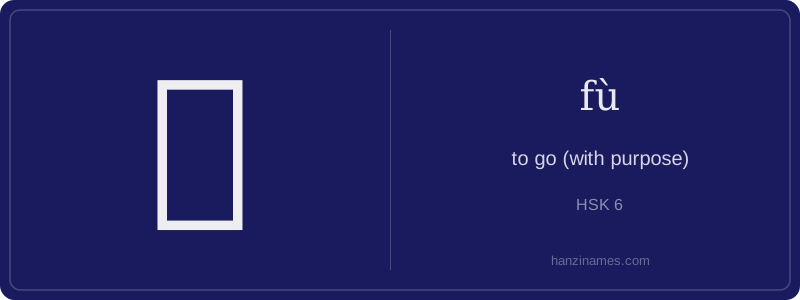
In modern Chinese usage, 赴 most commonly appears in formal or official contexts: 赴约 (fù yuē, 'to keep an appointment'), 赴任 (fù rèn, 'to assume office'), and 赴会 (fù huì, 'to attend a meeting/conference'). It's standard in news reports—for example, Xinhua regularly uses '国家主席赴俄罗斯进行国事访问' ('The President of China赴 Russia for a state visit'). The character also features in classical idioms like 赴汤蹈火 (fù tāng dǎo huǒ, 'to brave boiling water and scorching fire'), meaning unwavering devotion.
The character’s structure reflects its meaning: left radical 走 (zǒu, 'to walk') denotes motion; right component 夫 (fū) originally depicted a man wearing a ceremonial headdress (甲骨文 variant), later generalized to signify adult male agency and responsibility. While early forms aren’t pictographic sun/moon/tree, the combination clearly signals 'a person walking purposefully toward duty'—a documented semantic logic confirmed in Shuōwén Jiězì (121 CE).
Imagine a crisp autumn morning in Beijing’s Capital International Airport. A young scholar adjusts her glasses, clutching a passport and an acceptance letter from Peking University’s Confucius Institute. She takes a deep breath—this isn’t just travel; it’s a purposeful, committed journey. In Chinese, this intentional act of going *toward* something significant—be it duty, opportunity, or obligation—is precisely what 赴 (fù) conveys. Unlike generic verbs like 去 (qù), 赴 carries gravity: it implies resolve, formality, and forward motion with intention.
Historically, 赴 appears frequently in classical texts describing envoys dispatched to courts, officials traveling to posts, or scholars赴 examinations during imperial times. Its radical 走 (zǒu, ‘to walk’) anchors it in physical movement, while the right side 夫 (fū, ‘man’ or ‘husband’) historically signaled adult male agency—suggesting action taken by someone assuming responsibility. This duality—movement + commitment—makes 赴 indispensable in formal registers.
Today, you’ll see 赴 on university admission notices, diplomatic bulletins, and corporate press releases—never in casual chats about grabbing lunch. It’s the verb you use when your friend ‘attends’ an international summit, not when they ‘go’ to the supermarket. That subtle weight is why HSK Level 6 learners encounter it: mastering 赴 means grasping how Chinese encodes social seriousness into grammar itself—not just where you go, but *why* and *as whom* you go.
Example Sentences
Common Compounds
Similar Characters — Don't Mix These Up
Your First Step into Chinese Culture: Get a Chinese Name
Every journey into Chinese begins with a name. Use our free Chinese name generator to create a meaningful, personalized Chinese name that fits you perfectly.
Get My Chinese Name →