蹋
Character Story & Explanation
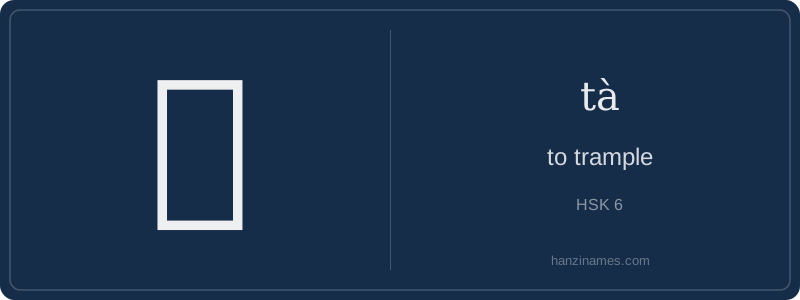
蹋 is rarely used alone in modern Mandarin; it appears primarily in compound words and literary or formal registers. Historically, it appears in classical texts like the Zuo Zhuan to describe military trampling of enemy territory, and in Tang poetry to evoke ruin or disrespect (e.g., '蹋破青苔' — 'trampling broken moss', symbolizing intrusion into quiet sanctity). Today, it survives most commonly in idioms like 蹋破铁鞋 (tà pò tiě xié, 'to wear out iron shoes') — meaning exhaustive searching — and in set phrases like 蹋青 (tà qīng, 'spring outing'), where it retains its gentle, rhythmic sense of treading lightly on grass.
The character’s form is not pictographic but phono-semantic: the left radical 足 denotes 'foot/leg action', while the right component 豆 (dòu, originally a ritual vessel) serves phonetically (though pronunciation diverged). No oracle-bone or bronze script form survives for 蹋 — it first appears reliably in Han dynasty clerical script. In daily life, Chinese speakers most often encounter it in printed warnings ('请勿蹋草坪' — 'Do not step on the lawn') or historical documentaries discussing cultural destruction.
At first glance, 蹋 (tà) appears simply as 'to step on' — a physical act of pressing down with the foot. Yet in Chinese worldview, the foot is never neutral: it carries moral weight. Stepping on something implies dominance, disrespect, or violation — whether a sacred text, a person’s dignity, or ancestral customs. The radical 足 (foot) anchors this meaning in embodied action, reminding learners that ethics in Chinese thought are enacted through posture, movement, and spatial awareness.
This character reflects Confucian and Daoist sensibilities where harmony depends on appropriate placement — of body, word, and will. To 'tread upon' (tà) is thus linguistically coded as transgression, not mere contact. Unlike English ‘step on’, which can be accidental or benign (e.g., ‘step on a crack’), 蹋 inherently suggests intentionality and consequence — echoing the classical idea that even small bodily acts ripple through social and cosmic order.
Moreover, 蹋 appears almost exclusively in negative or cautionary contexts: condemning cultural desecration, political overreach, or personal arrogance. Its rarity in neutral speech underscores a deeper cultural principle — reverence for boundaries. Whether stepping on a grave, a promise, or a tradition, the act signals rupture. Thus, 蹋 serves not just as a verb but as a linguistic checkpoint: a reminder that every footfall in Chinese thought may carry ethical gravity.
Example Sentences
Common Compounds
Similar Characters — Don't Mix These Up
Your First Step into Chinese Culture: Get a Chinese Name
Every journey into Chinese begins with a name. Use our free Chinese name generator to create a meaningful, personalized Chinese name that fits you perfectly.
Get My Chinese Name →