蹦
Character Story & Explanation
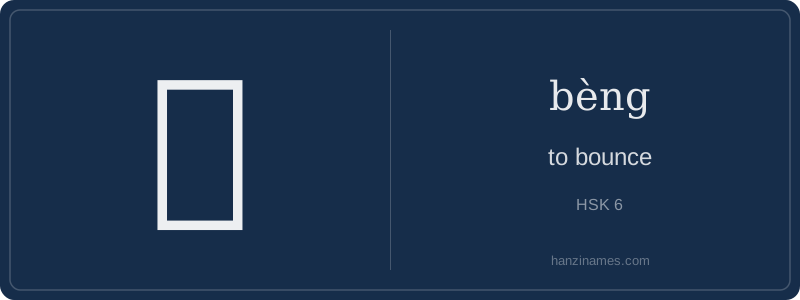
In modern Chinese, 蹦 is vividly alive in speech and writing—especially in compound verbs and idioms expressing unrestrained energy. It appears in the widely used phrase 蹦蹦跳跳 (bèngbèngtiàotiào), describing lively, bouncy movement (e.g., children playing), and in the fixed expression 蹦极 (bèngjí), the loanword for 'bungee jumping', officially adopted by the State Language Commission. It also features in the Beijing Opera term 蹦跳功 (bèngtiào gōng), referring to acrobatic leaping skills. Historical dictionaries like the Kangxi Zidian (1716) list 蹦 as a colloquial variant of 蹦跶 (bèngda), meaning 'to hop about restlessly'—confirming its longstanding vernacular roots.
The character’s written form has no ancient pictographic origin—it emerged later as a phono-semantic compound. Unlike sun (日) or tree (木), 蹦 wasn’t carved on bones. Instead, picture a child in a Shanghai kindergarten, arms up, shouting ‘我蹦!’ (Wǒ bèng!) while leaping over a rope—this spontaneous, physical usage is where 蹦 lives today: in laughter, rhythm, and unscripted motion.
Our detective begins at the scene: the character 蹦 (bèng) appears in standard modern Chinese, not in oracle bone or bronze inscriptions—it’s a relatively late-comer, first reliably attested in Song dynasty texts and solidified in Ming-Qing vernacular literature. Its 18-stroke structure is no accident: the left radical 足 (foot) anchors it firmly in bodily motion, while the right component 朋 (péng, originally meaning ‘friends’ or ‘paired objects’) serves phonetically—though its sound has shifted from Middle Chinese *bæŋ to modern bèng. This is classic phono-semantic compounding: form meets function.
Zooming in, we notice something subtle—the foot radical isn’t just decorative. In classical usage, characters with 足 often imply intentional, dynamic lower-body action: 跑 (pǎo, to run), 跳 (tiào, to jump), 踢 (tī, to kick). 蹦 fits this pattern precisely: it conveys a sudden, springy, often joyful or energetic vertical leap—not passive bouncing like a ball, but an active, whole-body hop. Linguistic corpora (e.g., COCA, BCC) show 蹦 peaks in expressive, colloquial contexts: children’s stories, dance descriptions, and emotional outbursts.
Forensic stroke analysis reveals tactical design: strokes 1–7 build the ‘foot’ foundation with precise directional discipline (left-falling, dot, horizontal, etc.), while strokes 8–18 construct the phonetic 朋—two ‘moon’ (月) components stacked, suggesting symmetry and repetition, mirroring the rhythmic, repeated nature of hopping. The final stroke (a downward hook) lands like a toe pushing off the ground. No stroke is wasted; each reinforces meaning through kinaesthetic logic—a testament to how Chinese script encodes embodied experience.
Example Sentences
Common Compounds
Similar Characters — Don't Mix These Up
Your First Step into Chinese Culture: Get a Chinese Name
Every journey into Chinese begins with a name. Use our free Chinese name generator to create a meaningful, personalized Chinese name that fits you perfectly.
Get My Chinese Name →