躁
Character Story & Explanation
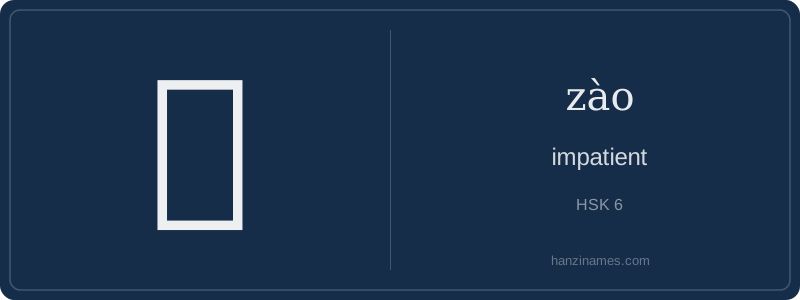
躁 is widely used in modern Mandarin in psychological, medical, and behavioral contexts. It appears in official diagnostic terms like 躁狂症 (zàokuángzhèng, bipolar I disorder) and in common phrases such as 心浮气躁 (xīn fú qì zào, 'restless heart and agitated qi'), a set expression cited in the 2020 edition of the Contemporary Chinese Dictionary. Teachers and parents frequently use 躁 to describe students who rush through exams or lose focus during study — reflecting its enduring link to self-discipline.
Written form: 躁 is a phono-semantic compound. The left radical 足 (foot) signals association with movement or behavior; the right component 單 (dān, simplified as 单) historically served as a phonetic hint (though pronunciation diverged). No oracle bone or bronze script form survives — its earliest attestation is in Warring States bamboo texts (4th c. BCE), where it consistently denotes uncontrolled agitation.
The Chinese character 躁 (zào) conveys a state of inner restlessness — not just anger, but a fidgety, agitated impatience that manifests physically and emotionally. Its radical 足 (foot) hints at bodily movement: pacing, stomping, or inability to stand still. Unlike English ‘angry’, which centers on emotion, 躁 emphasizes kinetic tension — the kind that makes someone tap fingers, interrupt conversations, or snap over minor delays.
In classical Chinese texts, 躁 appears in ethical discussions warning against hasty action. Confucius’ Analects (17.8) contrasts ‘gentlemanly composure’ with ‘petty men’s 躁’ — linking it to moral immaturity and poor self-cultivation. This philosophical framing persists: modern psychology in China often diagnoses ‘躁狂’ (zàokuáng, mania) as excessive energy without focus, echoing ancient concerns about imbalance.
Western equivalents like ‘irritable’, ‘edgy’, or ‘hot-headed’ capture parts of 躁, but miss its cultural weight. In Anglo-American contexts, impatience is often framed as situational (e.g., traffic stress), while 躁 implies deeper character vulnerability — akin to Aristotle’s ‘akrasia’ (weakness of will). Even ‘ADHD’ in Chinese discourse may be colloquially described as ‘太躁了’ (tài zào le), revealing how the term bridges medical, moral, and everyday judgment.
Example Sentences
Common Compounds
Similar Characters — Don't Mix These Up
Your First Step into Chinese Culture: Get a Chinese Name
Every journey into Chinese begins with a name. Use our free Chinese name generator to create a meaningful, personalized Chinese name that fits you perfectly.
Get My Chinese Name →