辖
Character Story & Explanation
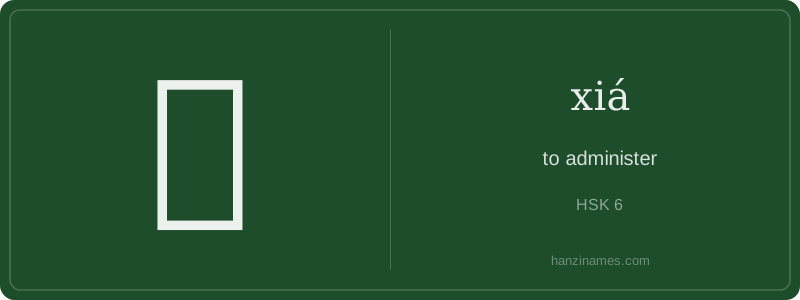
辖 is predominantly used in modern Chinese administrative language—e.g., '直辖市' (direct-controlled municipality), '辖区' (administrative jurisdiction), and official documents from the Ministry of Civil Affairs. It appears in the names of real entities like the Beijing Municipal Commission of Transport’s '交通执法总队辖区管理细则' (Regulations on Jurisdictional Management by the Traffic Law Enforcement Corps). It's also embedded in historical terms like '节度使辖地' (territory under a Tang dynasty military governor).
The character combines the radical 车 (chē, 'chariot/vehicle') and the phonetic component 狭 (xiá, 'narrow'). While not a pictograph, its composition reflects ancient association: chariots required precise axle control—hence the link between 'vehicle mechanism' and 'regulatory authority.' The 'narrow' component suggests bounded scope, reinforcing the idea of delimited, enforceable jurisdiction.
The Chinese character 辖 (xiá) conveys authority, control, and jurisdiction—specifically the administrative power to govern or manage a defined territory or domain. Though often translated as 'to administer' or 'to have jurisdiction over,' its deeper resonance lies in structural centrality: like a linchpin holding a wheel assembly together, 辖 implies indispensable oversight that ensures functional cohesion. It appears almost exclusively in formal, bureaucratic, or institutional contexts—not casual speech—reflecting China’s long-standing emphasis on hierarchical governance and territorial integrity.
In classical usage, 辖 appeared in texts like the Book of Han (c. 1st century CE) referring to imperial control over frontier commanderies. Its semantic weight evolved but retained a sense of binding authority—neither mere supervision nor passive oversight, but active, legitimate, and system-anchoring regulation. This contrasts with Western notions of delegated management; 辖 carries implicit legitimacy derived from institutional mandate, not individual expertise or contractual agreement.
Western equivalents like 'linchpin' (mechanical metaphor), 'jurisdiction' (legal), or 'mandate' (political) only partially overlap. Unlike 'linchpin,' which emphasizes critical function without hierarchy, 辖 inherently implies top-down authority. Compared to 'jurisdiction,' it’s more action-oriented—less about legal boundaries, more about exercised control. In governance, it mirrors concepts like 'sovereign administration' or 'executive purview'—but always grounded in Confucian-inflected administrative tradition where order flows from legitimate, centralized stewardship.
Example Sentences
Common Compounds
Similar Characters — Don't Mix These Up
Your First Step into Chinese Culture: Get a Chinese Name
Every journey into Chinese begins with a name. Use our free Chinese name generator to create a meaningful, personalized Chinese name that fits you perfectly.
Get My Chinese Name →