迄
Character Story & Explanation
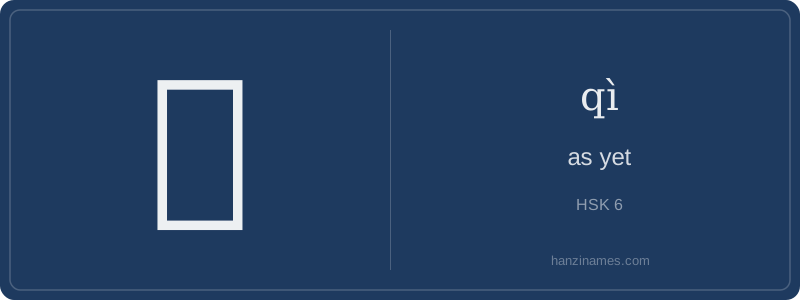
In contemporary China, 迄 appears routinely in official communications — from municipal government bulletins announcing infrastructure delays ('工程迄未竣工') to university research summaries ('该理论迄未被实证验证'). It’s also embedded in widely used set phrases like 迄今为止 (qìjīn wéizhǐ, 'up to now'), which appears over 2 million times in the official People’s Daily database (1946–2023). Unlike colloquial alternatives, 迄 carries authoritative weight and implies measured, documented observation.
The character’s form combines 辶 (walking radical, indicating movement/continuity) and 乞 (qǐ, originally 'to beg', here serving phonetically). Per the *Shuōwén Jiězì* (121 CE), 迄 was defined as 'to reach, to arrive' — evolving semantically from physical arrival to temporal culmination. Its modern 'as yet' sense emerged during the late Ming and Qing dynasties in bureaucratic memorials, where precision in marking unfulfilled deadlines was essential.
迄 (qì) is a formal, literary character meaning 'as yet', 'up to now', or 'so far'. It conveys temporal boundary — not just time elapsed, but the absence of completion or change. Unlike common words like yǐjīng (already) or hái méi (not yet), 迄 emphasizes continuity up to a stated point, often with a tone of expectation or suspense. It appears almost exclusively in written Chinese: official documents, news reports, academic papers, and classical-style prose.
This character belongs to the 辶 (chuò) radical — the 'walking' or 'movement' radical — which hints at progression through time or space. Though it looks simple (just six strokes), its usage is highly constrained: native speakers rarely say it aloud in daily speech; it’s a marker of register, signaling formality and precision. Its presence instantly elevates the tone of a sentence, much like using 'hitherto' instead of 'so far' in English.
迄 is frequently paired with other time-related characters like 今 (now), 止 (stop), or 未 (not yet), forming compound expressions such as 迄今 (qìjīn, 'to date') or 迄未 (qì wèi, 'as yet not'). These phrases are staples in legal notices, research abstracts, and policy updates — for example, '迄未收到反馈' ('No feedback has been received as yet'). Mastery of 迄 reflects advanced literacy, fitting its HSK Level 6 status.
Example Sentences
Common Compounds
Similar Characters — Don't Mix These Up
Your First Step into Chinese Culture: Get a Chinese Name
Every journey into Chinese begins with a name. Use our free Chinese name generator to create a meaningful, personalized Chinese name that fits you perfectly.
Get My Chinese Name →