慢
Character Story & Explanation
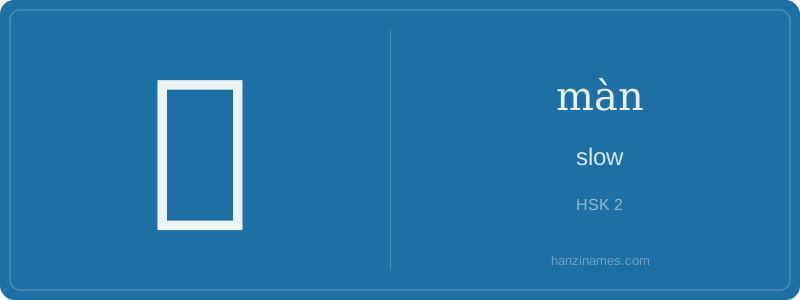
In Beijing’s hutongs, a tea master gestures gently as he pours hot water over oolong leaves—'慢慢来' (màn man lái), he says: 'Take it slowly.' This phrase, ubiquitous in daily life, embodies the positive cultural weight of 慢: patience, respect for process, and resistance to haste. Common compounds include 慢性病 (mànxìngbìng, chronic illness) and 慢车道 (màndàochēdào, bicycle lane), both standardized in national road signage and medical terminology since the 1950s.
Historically, 慢 first appeared in seal script (c. 3rd century BCE) as a phonosemantic compound: 忄 (heart/mind radical) + 曼 (màn, phonetic, meaning 'extended, prolonged'). No pictographic origin exists; its structure reflects systematic Han dynasty standardization—not oracle-bone invention—and has remained stable for over 2,200 years.
The character 慢 (màn) conveys the core idea of 'slowness'—not just physical pace, but also temporal delay, relaxed tempo, or even psychological attitudes like indifference or arrogance. Its left-side radical 忄 (the 'heart-mind' component) reveals that ancient Chinese associated slowness with internal states: a calm mind, deliberate action, or sometimes, dismissive aloofness.
In modern usage, 慢 appears in contexts ranging from traffic signs ('slow down') to music ('adagio'), and even interpersonal conduct ('don’t be arrogant'). Unlike English 'slow', which is largely neutral or negative, 慢 carries nuanced valence—it’s praised in mindfulness (慢生活, slow living) but criticized in negligence (慢待, to treat carelessly).
This duality reflects a deeper cultural value: slowness as virtue when intentional and mindful, but as flaw when careless or disrespectful. The character thus bridges concrete motion and abstract ethics—a hallmark of Chinese character semantics where form, sound, and meaning intertwine across millennia of written use.
Example Sentences
Common Compounds
Similar Characters — Don't Mix These Up
Your First Step into Chinese Culture: Get a Chinese Name
Every journey into Chinese begins with a name. Use our free Chinese name generator to create a meaningful, personalized Chinese name that fits you perfectly.
Get My Chinese Name →