逮
Character Story & Explanation
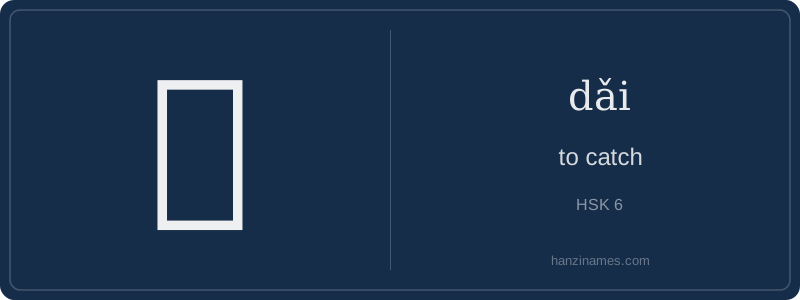
In modern Chinese, 逮 is most commonly heard in spoken Mandarin as dǎi in informal contexts—especially in northern dialects—to mean ‘to catch’ or ‘to grab’, often with immediacy and physicality. It appears in legal terminology (e.g., 逮捕, ‘arrest’) pronounced dài, reflecting its formal, HSK 6–level usage in news, law, and official documents. A well-documented phrase is 逮个正着 (dǎi gè zhèngzhe), meaning ‘to catch red-handed’, frequently used in media reports and court transcripts.
The character is not pictographic; it’s a standardized semantic-phonetic compound from the Qin–Han unification era. Its form has remained stable since clerical script (c. 200 BCE), with no oracle bone or bronze inscriptions found—so instead, picture this: a Beijing police officer saying on radio, ‘嫌疑人刚出门,快去逮!’ (‘Suspect just left—go grab him!’)—that’s 逮 in its living, urgent, everyday voice.
As a detective tracing 逮’s evolution, I begin at its modern form: a clear semantic-phonetic compound. The radical 辶 (chuò), meaning 'to walk' or 'movement', frames the right side and signals motion—essential for an action like catching. Inside sits the phonetic component 代 (dài), hinting at pronunciation while subtly reinforcing temporal urgency: to 'catch' is to act *in time*, before escape.
Historically, 逮 first appears in classical texts like the *Zuo Zhuan* (c. 4th century BCE) as a formal, often legal verb meaning 'to apprehend'—used for officials seizing suspects or rulers capturing rebels. Its early bronze script precursors aren’t extant, but seal script forms already show the familiar 辶 + 代 structure, confirming its deliberate construction during the Warring States period for administrative precision.
The dual pronunciations tell another layer of the story: dǎi dominates in colloquial speech (e.g., 逮住 ‘grab hold’), while dài persists in formal, literary, or legal contexts (e.g., 逮捕 ‘arrest’). This split reflects Chinese’s broader pattern where phonetic shifts preserve register distinctions—dǎi is the spoken fingerprint; dài is the written seal.
Example Sentences
Common Compounds
Similar Characters — Don't Mix These Up
Your First Step into Chinese Culture: Get a Chinese Name
Every journey into Chinese begins with a name. Use our free Chinese name generator to create a meaningful, personalized Chinese name that fits you perfectly.
Get My Chinese Name →