逊
Character Story & Explanation
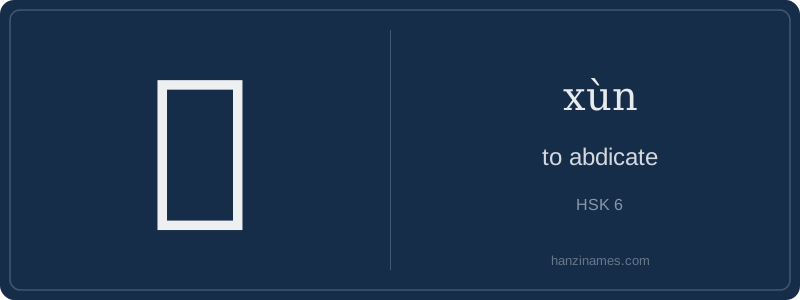
逊 is most famously used in the phrase 禅让制 (shàn ràng zhì), the ancient Chinese system of 'abdicative succession', where legendary emperors like Yao and Shun voluntarily passed the throne to worthy successors — a model of virtue celebrated in Confucian texts. Today, it appears in formal journalism (e.g., 'he 逊位 amid public pressure') and academic discourse on governance. While rare in casual speech, it remains vital in historical, legal, and political vocabulary.
The character’s structure reflects its meaning: the upper part 日 (rì, 'sun') historically symbolized brightness/authority; the 辶 radical ('walking') suggests movement away — together, 'stepping away from the seat of power'. This analysis aligns with Shuōwén Jiězì (100 CE), the earliest Chinese dictionary, which defines 逊 as 'to yield respectfully' — confirming its classical association with moral withdrawal.
Hi students! The character 逊 (xùn) is a Level 6 HSK word — meaning it’s advanced but very meaningful. At its core, 逊 means 'to abdicate' — to step down from power or position voluntarily, especially in formal or historical contexts. It’s not used for everyday quitting (like leaving a job), but rather for dignified, often ceremonial surrender of authority, like an emperor yielding the throne. Its tone is serious and respectful.
Don’t confuse 逊 with simple words like 'give up' — it carries weight and moral nuance. In classical Chinese, it appears frequently in texts about virtue, humility, and proper conduct among rulers and scholars. Even today, it shows up in formal writing, news reports about political transitions, and idioms emphasizing modesty or yielding to righteousness.
This character belongs to the 辶 (chuò) radical — the 'walking' or 'movement' radical — which hints at action or progression. Indeed, abdicating is an act: a deliberate, forward-moving choice to withdraw. Its 9 strokes follow a clear pattern: first the 'sun' component (日) on top, then the 'walking' radical wrapping around the bottom right. Practice slowly — stroke order matters for clarity and memory!
Example Sentences
Common Compounds
Similar Characters — Don't Mix These Up
Your First Step into Chinese Culture: Get a Chinese Name
Every journey into Chinese begins with a name. Use our free Chinese name generator to create a meaningful, personalized Chinese name that fits you perfectly.
Get My Chinese Name →