遮
Character Story & Explanation
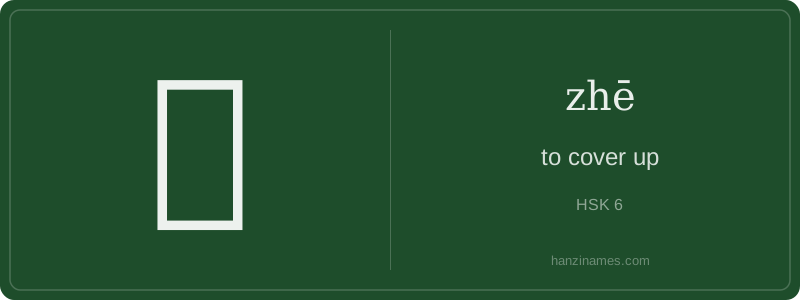
In daily life, 遮 appears in ubiquitous phrases like 遮阳伞 (zhēyángsǎn, 'sun-shading umbrella') — a staple in summer markets and school entrances across China. It’s central in the idiom 遮人耳目 (zhē rén ěr mù, 'to cover people’s ears and eyes'), used historically in Ming-Qing texts to describe political obfuscation, and still applied critically in modern journalism. The HSK 6 exam frequently tests its use in abstract contexts, such as 遮掩错误 (zhēyǎn cuòwù, 'to cover up a mistake').
The character evolved from seal script: the left component 者 was phonetic, while 辶 (the 'walking' radical) indicated motion-related action — consistent with its semantic role in verbs of positioning or intervention. No oracle-bone form survives, but early bronze inscriptions show its use in administrative records concerning resource allocation, where 'covering' referred to allocating protective quotas (e.g., grain reserves 'covered' for famine relief).
At first glance, 遮 (zhē) means 'to cover up' — but in the Chinese worldview, covering is never merely physical. It carries layers of intention: protection, concealment, modesty, or even moral restraint. Unlike Western binaries of 'truth vs. deception,' 遮 reflects a relational ethics — what to reveal and when depends on context, hierarchy, and harmony. A curtain doesn’t just block light; it preserves dignity. A gesture that hides one’s face isn’t evasion — it’s deference.
This character embodies the Confucian ideal of *li* (ritual propriety): boundaries maintained through gentle obstruction. To 遮 is to mediate — between self and other, private and public, known and unknown. Even in modern China, where transparency is increasingly valued, 遮 persists in nuanced forms: blurring faces in documentaries (to protect privacy), editing sensitive terms online (not as censorship alone, but as social calibration), or using umbrellas not just against rain, but to preserve personal space in crowded subways.
The radical 辶 (chuò), meaning 'walking' or 'movement', fused with 者 (zhě, 'one who...'), suggests an active, deliberate act — not passive hiding, but purposeful intervention in visibility. This mirrors traditional Chinese aesthetics: ink-wash paintings often use mist (遮) to suggest depth, not obscure it. What is covered invites imagination; what is revealed must earn attention. Thus, 遮 is not absence — it’s curated presence, a quiet assertion of agency within relational space.
Example Sentences
Common Compounds
Similar Characters — Don't Mix These Up
Your First Step into Chinese Culture: Get a Chinese Name
Every journey into Chinese begins with a name. Use our free Chinese name generator to create a meaningful, personalized Chinese name that fits you perfectly.
Get My Chinese Name →