钝
Character Story & Explanation
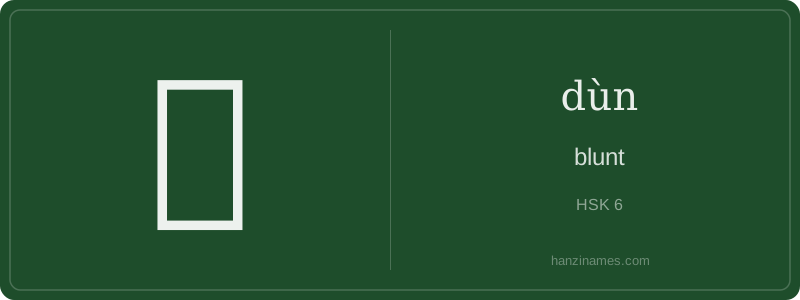
In daily life, 钝 appears in standardized medical terminology (e.g., 钝痛 dùn tòng, 'dull pain')—a key descriptor in China’s national clinical guidelines for pain assessment. It’s also central to the idiom 大智若愚,大巧若拙,大勇若钝 (dà zhì ruò yú, dà qiǎo ruò zhuō, dà yǒng ruò dùn), quoted in the *Huainanzi* (2nd c. BCE), praising profound wisdom that appears unpolished or 'blunt'. Modern usage includes tech reviews ('系统反应太钝') and education policy critiques ('教学方式让思维变钝').
The character is not pictographic but phono-semantic: 钅 (metal radical) signals category; 屯 (tún) provides sound. No oracle-bone or bronze inscriptions of 钝 exist—its earliest attestation is in Han dynasty texts. Today, Chinese people commonly use it while shopping for kitchenware ('这把剪刀很钝'), during health checkups ('触觉稍钝'), or describing AI limitations ('模型对细微差异反应较钝').
Imagine a Beijing chef in a bustling hutong kitchen, testing his cleaver on a bamboo cutting board. He frowns—the blade slides off the ginger root instead of slicing cleanly. '这刀太钝了!' he sighs. 钝 (dùn) captures that precise moment: not broken, not missing—but functionally impaired by loss of edge. It’s a tactile, sensory word rooted in physical resistance, widely used beyond tools to describe mental sluggishness or emotional dullness.
In Mandarin, 钝 carries strong evaluative weight—it implies a deficit needing correction. Unlike neutral terms like ‘soft’ or ‘mild’, 钝 suggests underperformance: a dull knife cuts poorly; a 钝感的人 misses social cues. This semantic gravity makes it common in education (e.g., criticizing rote learning that dulls curiosity) and medicine (e.g., 钝痛 meaning 'dull ache', a clinically standardized term in Chinese medical texts).
The character’s metallic radical (钅) anchors it firmly in the realm of tools and material properties—reinforcing that its core meaning arises from observable, physical bluntness. Its 9-stroke structure is streamlined yet balanced: four strokes for the metal radical on the left, five for the phonetic component 屯 (tún), which hints at pronunciation without carrying meaning. This reflects classical Chinese character design logic: combine semantic clarity with phonetic guidance.
Example Sentences
Common Compounds
Similar Characters — Don't Mix These Up
Your First Step into Chinese Culture: Get a Chinese Name
Every journey into Chinese begins with a name. Use our free Chinese name generator to create a meaningful, personalized Chinese name that fits you perfectly.
Get My Chinese Name →