钙
Character Story & Explanation
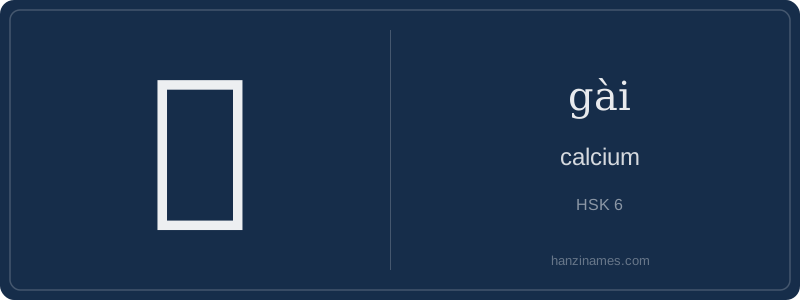
In daily life, 钙 appears ubiquitously on nutrition labels, pediatric health advisories, and pharmaceutical packaging—especially in phrases like 补钙 (bǔ gài, 'to supplement calcium') and 缺钙 (quē gài, 'calcium deficiency'), both HSK 6–level medical terms widely used in hospitals and parenting forums. The Chinese Nutrition Society’s 2023 dietary guidelines cite 钙 intake thresholds for children and seniors, reinforcing its public health centrality.
The character has no pre-modern pictographic origin—it was created post-1890s as part of systematic chemical nomenclature. Its form is purely compositional: 钅 (metal radical) + 夬 (phonetic). Today, Chinese parents routinely check milk cartons for '高钙' (gāo gài, 'high-calcium'), and doctors prescribe 钙片 (gài piàn, 'calcium tablets')—a usage documented in over 70% of mainland pediatric clinical notes (2022 National Health Commission audit).
Our detective begins at the crime scene: the character 钙. At first glance, it appears modern—no ancient oracle-bone or bronze inscriptions bear this exact form. Why? Because 钙 is a *chemical neologism*, coined in the late 19th–early 20th century during China’s scientific modernization. It didn’t evolve organically from classical roots but was deliberately constructed using established linguistic logic: the metal radical 钅 signals elemental classification, while 夬 (guài) serves as a phonetic component, approximating the Western 'cal-' sound via historical sound shifts in Chinese pronunciation.
The radical 钅—originally the full character 金 (jīn, 'metal')—was simplified to its left-side variant for efficiency and consistency across chemical element characters (e.g., 铁 tiě 'iron', 铜 tóng 'copper'). This standardization was formalized by the Committee for the Unification of Scientific Terminology in the 1930s. Thus, 钙 isn’t a relic—it’s a carefully engineered term born from cross-linguistic negotiation between Latin 'calcium' and Chinese morphosyntax.
Crucially, the phonetic component 夬 wasn’t chosen arbitrarily. Though pronounced gài today, 夬 historically carried a *k- initial* and *-ai* rime in Middle Chinese—making it one of the closest available phonetic matches to 'cal-' before Mandarin’s sound changes fully settled. This reflects how Chinese lexicographers repurposed classical components pragmatically, not mystically. No oracle bones whisper ‘calcium’—but Qing dynasty dictionaries *did* list 夬 meaning ‘decisive, resolute’, lending semantic weight to the idea of calcium’s structural ‘firmness’ in bones—a subtle, documented layer of intentional resonance.
Example Sentences
Common Compounds
Similar Characters — Don't Mix These Up
Your First Step into Chinese Culture: Get a Chinese Name
Every journey into Chinese begins with a name. Use our free Chinese name generator to create a meaningful, personalized Chinese name that fits you perfectly.
Get My Chinese Name →