铜
Character Story & Explanation
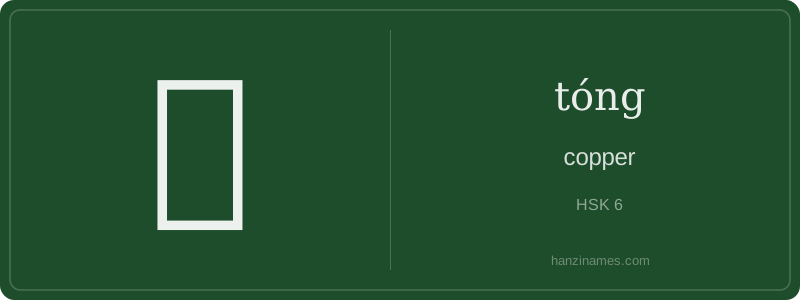
In Beijing’s Panjiayuan Antique Market, vendors display Ming-era copper incense burners and Qing dynasty copper coins—each bearing the character 铜 in inscriptions or catalog descriptions. The term 铜钱 (tóngqián) historically denoted standard cash coins cast from bronze (copper-tin alloy) for over two millennia, until the late Qing. Today, 铜 appears in technical contexts (e.g., electrical standards), financial slang (铜臭), and compound words like 青铜 (qīngtóng, 'bronze'), referencing China’s most iconic metallurgical achievement.
The character 铜 first appeared in seal script (c. 3rd century BCE) as a semantic-phonetic compound: 钅 (metal radical) + 同 (tóng, phonetic). No pictographic origin exists—it was never drawn as copper ore or metal; instead, it emerged fully formed as a logical, standardized character during Qin unification, reflecting administrative standardization of writing.
铜 (tóng) is a key character for metals in Chinese, representing copper—the reddish-brown element essential to ancient bronzes and modern electronics. Its left-side radical 钅 (‘metal’) instantly signals its category, while the right component 同 (tóng, meaning 'same') serves as a phonetic hint, guiding pronunciation. This structure reflects the systematic logic of Chinese characters: meaning + sound.
Historically, copper was foundational to China’s Bronze Age—Shang and Zhou dynasty ritual vessels were cast from bronze (an alloy of copper and tin), inscribed with early script and used in ancestral rites. Even today, ‘copper’ evokes durability and tradition, appearing in idioms like 铜墙铁壁 (copper wall, iron fortress)—a metaphor for impregnable defense.
In contemporary China, 铜 appears everywhere: on currency (though modern coins are mostly steel-plated), in engineering terms (e.g., 铜线 tóngxiàn, copper wire), and in cultural expressions like 铜臭 (tóngxiù, 'copper stench'), an ironic term for the corrupting influence of money. Its HSK Level 6 status reflects its specialized yet culturally rich usage beyond basic vocabulary.
Example Sentences
Common Compounds
Similar Characters — Don't Mix These Up
Your First Step into Chinese Culture: Get a Chinese Name
Every journey into Chinese begins with a name. Use our free Chinese name generator to create a meaningful, personalized Chinese name that fits you perfectly.
Get My Chinese Name →