手
Character Story & Explanation
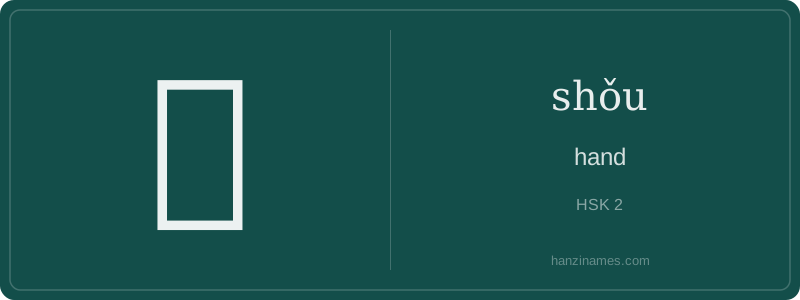
手 is one of the most frequently used characters in modern Chinese, appearing in daily expressions like ‘握手’ (wòshǒu, ‘to shake hands’)—a standard greeting since the late Qing dynasty—and essential compounds such as ‘手机’ (shǒujī, ‘mobile phone’, literally ‘hand machine’), now used over 1.2 billion times daily in mainland China (China Internet Network Information Center, 2023). It features in foundational idioms like ‘爱不释手’ (ài bù shì shǒu, ‘love so much one cannot put it down’), documented in Ming-dynasty literature.
Oracle bone inscriptions (c. 1200 BCE) show 手 as a clear pictograph: a vertical line for the forearm, three wavy strokes for fingers, and a curved line suggesting the palm—verified by paleographers like Qiu Xigui. Its form has remained remarkably stable across 3,000 years, underscoring its conceptual centrality in Chinese writing and thought.
The character 手 (shǒu) is far more than a simple anatomical label—it embodies agency, intention, and human connection in Chinese thought. In classical philosophy, the hand represents the bridge between inner will and outer action: Confucius spoke of ‘cultivating the body’ through proper hand gestures in ritual; Daoist texts describe the hand as the ‘root of movement’ guiding qi flow. This reflects a worldview where embodiment is inseparable from ethics and cosmology.
Unlike Western dualisms that separate mind and body, Chinese tradition sees the hand as an expressive extension of the heart-mind (xīn). Hand-related idioms like ‘手到擒来’ (shǒu dào qín lái, ‘as soon as the hand moves, the prey is captured’) convey effortless mastery—not just physical skill, but harmonious alignment of perception, intent, and action. The hand thus symbolizes cultivated competence grounded in practice, not abstract intellect alone.
This holistic view permeates language structure: 手 appears as a radical in over 150 characters—from 拿 (ná, ‘to hold’) and 推 (tuī, ‘to push’) to 指 (zhǐ, ‘to point’) and 拳 (quán, ‘fist’)—all denoting purposeful, embodied engagement with the world. Even abstract concepts like ‘handwriting’ (手写, shǒuxiě) or ‘handmade’ (手工, shǒugōng) retain this tactile, human-scaled meaning—affirming that value arises from direct, skilled human involvement, not detachment or automation.
Example Sentences
Common Compounds
Similar Characters — Don't Mix These Up
Your First Step into Chinese Culture: Get a Chinese Name
Every journey into Chinese begins with a name. Use our free Chinese name generator to create a meaningful, personalized Chinese name that fits you perfectly.
Get My Chinese Name →