锈
Character Story & Explanation
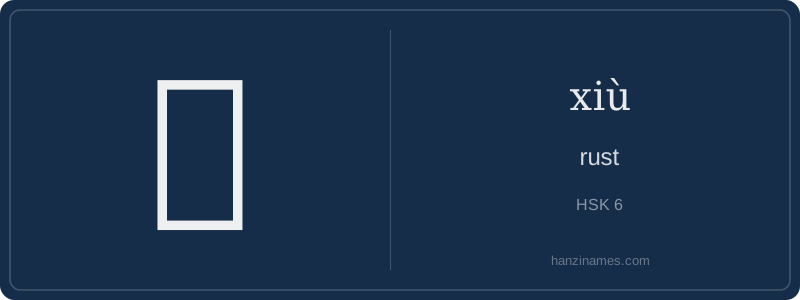
锈 is commonly used in technical, industrial, and everyday contexts across China—from maintenance manuals for high-speed rail infrastructure (where anti-rust coatings are critical) to household warnings like '铁锅易生锈,请擦干存放' ('Iron woks rust easily—dry thoroughly before storing'). A well-documented phrase is 防锈漆 (fáng xiù qī, 'anti-rust paint'), standardized in national construction codes (GB/T 7692–2019). The idiom '锈迹斑斑' (xiù jì bān bān, 'heavily rusted') appears in historical descriptions of Ming Dynasty bronze cannons recovered from coastal shipwrecks.
The character 锈 first appeared in clerical script during the Han Dynasty (206 BCE–220 CE), evolving from earlier forms combining 'metal' and 'show/ripen' (秀) as a phonetic loan. It is not pictographic; its structure reflects phonetic borrowing rather than visual representation. Today, Chinese engineers, students, and homeowners routinely use it in safety signage, chemistry textbooks, and DIY repair guides.
锈 (xiù) is the standard Chinese character for 'rust'—the reddish-brown iron oxide that forms when iron or steel corrodes in moist air. Unlike English, where 'rust' functions as both noun and verb, 锈 is primarily a noun; the verb 'to rust' is usually expressed with the compound verb 生锈 (shēng xiù), literally 'to generate rust.' This reflects Chinese’s preference for verb–result compounds to express change-of-state actions.
Culturally, rust carries strong connotations of neglect, decay, and obsolescence—not just physical deterioration but metaphorical stagnation. In Western contexts, rust often symbolizes industrial decline (e.g., America’s 'Rust Belt'), while in Chinese discourse, it frequently appears in political or technological rhetoric: '防止思想生锈' ('prevent ideological rust') warns against intellectual complacency, echoing Confucian ideals of continuous self-cultivation.
The radical 钅 (jīn zì páng), meaning 'metal,' anchors 锈 firmly in the domain of metallurgy and material science. Its right component, 秀 (xiù), originally meant 'grain ripening' and later came to signify 'excellence' or 'beauty'—a striking semantic contrast to corrosion. This phonetic-semantic compound exemplifies how Chinese characters often pair sound cues (秀) with meaning hints (钅), even when the phonetic component no longer perfectly matches modern pronunciation.
Example Sentences
Common Compounds
Similar Characters — Don't Mix These Up
Your First Step into Chinese Culture: Get a Chinese Name
Every journey into Chinese begins with a name. Use our free Chinese name generator to create a meaningful, personalized Chinese name that fits you perfectly.
Get My Chinese Name →