阐
Character Story & Explanation
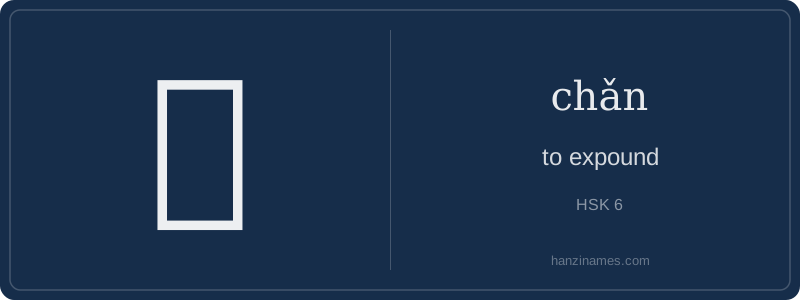
阐 is standard in formal written Chinese—especially in education, law, and official discourse. It appears in the phrase 阐明立场 (chǎnmíng lìchǎng, 'clarify one’s position'), used regularly in Xinhua News Agency reports and diplomatic statements. The idiom 阐幽明微 (chǎn yōu míng wēi, 'elucidate the obscure and illuminate the subtle') dates back to Song dynasty scholarly commentaries and remains in academic writing today.
The character is a phono-semantic compound: 门 (mén, 'gate/door') is the semantic radical, suggesting openness or revelation; the phonetic component is 单 (dān, now simplified as 单, historically pronounced close to chǎn in Middle Chinese). Though not pictographic, its structure visually reinforces its meaning—'opening the door to meaning.' In daily life, Chinese people encounter 阐 most often in textbooks, policy documents, or university lectures—not conversation, but contexts demanding precision and exposition.
Imagine a quiet university lecture hall in Beijing, where Professor Li stands before a whiteboard covered in classical Chinese texts. She points to the character 阐 and says, 'This isn’t just “to say”—it’s to open up meaning like unlocking a door. The radical 门 (door) hints at revelation: when you 阐明 something, you don’t merely state it—you swing the gate wide for understanding.'
The character appears frequently in academic, legal, and policy contexts. At China’s National People’s Congress, delegates use 阐述 to formally present interpretations of new regulations. Its tone is precise, respectful, and weighty—never casual. You’d never text ‘我阐一下’ to a friend; this is language for clarity under scrutiny, for bridging gaps between complex ideas and public comprehension.
Unlike simpler verbs like 说 (shuō, 'to speak'), 阐 carries an expectation of depth and structure. It implies analysis, contextualization, and pedagogical intent. Think of a scholar 阐发 Confucian ethics—not reciting quotes, but tracing historical evolution, comparing interpretations, and connecting ancient thought to modern governance. That’s why it’s HSK Level 6: it demands conceptual maturity, not just vocabulary recall.
Example Sentences
Common Compounds
Similar Characters — Don't Mix These Up
Your First Step into Chinese Culture: Get a Chinese Name
Every journey into Chinese begins with a name. Use our free Chinese name generator to create a meaningful, personalized Chinese name that fits you perfectly.
Get My Chinese Name →