陡
Character Story & Explanation
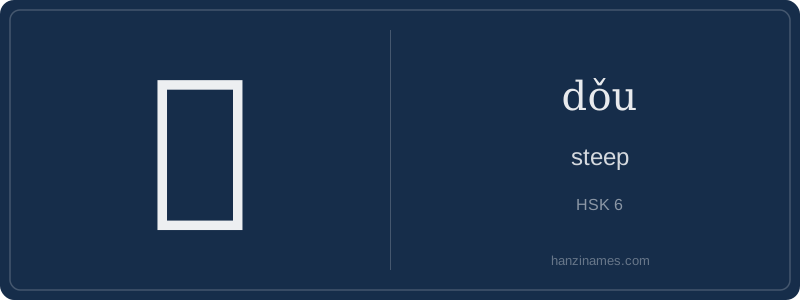
In modern Chinese, 陡 is commonly used in geography, travel writing, engineering reports, and weather forecasts — for example, warning of 陡坡 (steep slopes) on mountain highways or describing 陡降 (sharp drop) in air pressure before storms. It appears in the standard phrase 陡然 (dǒu rán), meaning 'suddenly' — a fixed adverbial expression widely used in literature and news. The idiom 陡壁悬崖 (dǒu bì xuán yá, sheer cliffs and precipitous ravines) is also well-documented in classical and modern descriptive texts.
The character evolved from seal script; the left radical 阝 (originally 阜, fù, meaning 'mound' or 'hillock') clearly relates to terrain, while the right component 尤 was borrowed phonetically and semantically for emphasis. There’s no verified oracle-bone form — but by the Han dynasty, 陡 already appeared in texts like the *Shuōwén Jiězì* dictionary as meaning 'steep', confirming its long-standing use for abrupt elevation.
Hi students! Let’s explore 陡 (dǒu), a character that describes something sharply rising or falling — like a cliff face or a sudden hill. It’s pronounced with the third tone, so remember to dip your voice: dǒu. Though it looks simple, its meaning is vivid and physical — not just ‘steep’ as in a gentle slope, but truly abrupt, almost dangerous in its incline. You’ll often see it describing terrain, roads, or even sudden changes — like a steep rise in temperature!
This character belongs to HSK Level 6, meaning it appears in advanced vocabulary — but don’t be intimidated! Its structure is logical: the left side 阝 (the ‘hill’ or ‘city’ radical, here representing terrain) pairs with the right side 尤 (yóu), which originally meant ‘especially’ or ‘particularly’. Together, they suggest ‘especially steep’ — an intensified degree of incline. That makes sense: 陡 doesn’t mean ‘a little up’, but *very* up!
As a beginner, focus first on recognizing 陡 in context — especially in compound words like 陡坡 (dǒu pō, steep slope) or 陡然 (dǒu rán, suddenly). Note how it’s used both literally (geography) and figuratively (sudden change). Practice writing it with 9 strokes — start at the top-left, follow the stroke order carefully, and pay attention to the small hook in the final stroke of 尤. Repetition builds muscle memory — and confidence!
Example Sentences
Common Compounds
Similar Characters — Don't Mix These Up
Your First Step into Chinese Culture: Get a Chinese Name
Every journey into Chinese begins with a name. Use our free Chinese name generator to create a meaningful, personalized Chinese name that fits you perfectly.
Get My Chinese Name →