隘
Character Story & Explanation
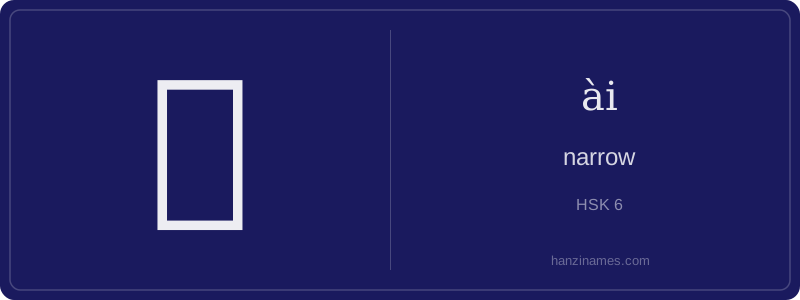
In modern usage, 隘 appears primarily in formal, literary, or geographical contexts—not daily speech. It survives in fixed terms like 关隘 (guānài, 'mountain pass/fortified gateway') and in idioms such as ‘一夫当关,万夫莫开’ (one man at the pass, ten thousand cannot open it), where 隘 underpins the strategic imagery. Historical texts (e.g., Zuo Zhuan, Records of the Grand Historian) consistently use it for defensible terrain features.
The character’s form is well-documented: 阝 is the ‘hill/mound’ radical (阜), and 厄 (è) is a phonetic-semantic component meaning ‘to obstruct’ or ‘peril,’ appearing independently in oracle bone inscriptions. Together, they form a phono-semantic compound—no pictographic sun/moon/tree origin; rather, a deliberate, functional construction attested since early seal script (c. 3rd c. BCE).
As an archaeologist brushing dust from a Han dynasty bamboo slip, I find 隘 etched not as abstract ideogram—but as a topographic relic. Its right side, 厄, depicts a person trapped in a constricted space (the 'crossed arms' radical over 'mouth' 口), while the left-side radical 阝 (originally 阜, meaning 'mound' or 'hill') signals terrain: thus, a narrow mountain pass—geographically precise, militarily vital.
This character was never about mere width; it encoded strategic vulnerability. In excavated military manuals from Mawangdui (2nd c. BCE), 隘 appears repeatedly in passages on defending choke points—'controlling the 隘 determines victory.' Its twelve strokes map a real-world constraint: steep slopes, limited visibility, and forced movement—a cognitive fossil of ancient frontier logistics.
Unlike generic synonyms like 窄 (narrow in measurement), 隘 carries gravitational weight: it implies *consequence* of narrowness—danger, difficulty, or exclusion. The radical 阝 roots it in land, not abstraction. When Sima Qian wrote of Qin’s ‘ten thousand 隘’ guarding its western borders, he wasn’t describing width—he was invoking geopolitical gravity, a concept still embedded in modern Chinese cartography and defense discourse.
Example Sentences
Common Compounds
Similar Characters — Don't Mix These Up
Your First Step into Chinese Culture: Get a Chinese Name
Every journey into Chinese begins with a name. Use our free Chinese name generator to create a meaningful, personalized Chinese name that fits you perfectly.
Get My Chinese Name →