隶
Character Story & Explanation
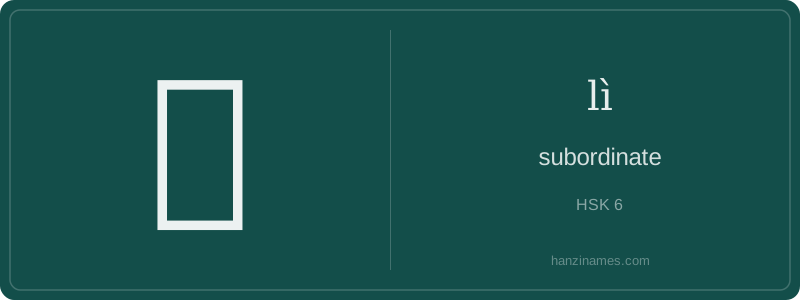
In modern Chinese, 隶 appears almost exclusively in fixed compounds and literary/historical contexts — never in casual speech. Its most frequent usage is in the phrase 隶属 (lìshǔ), meaning 'to be subordinate to' or 'under the jurisdiction of', widely used in legal documents, corporate hierarchies, and administrative announcements (e.g., '该机构隶属教育部' — 'This institution is subordinate to the Ministry of Education'). It also appears in the classical idiom '隶首作数' (Lì Shǒu invented arithmetic), referencing a legendary Qin-era scribe credited with standardizing calculation methods.
The character 隶 originated as a pictograph in early seal script (c. 3rd century BCE), depicting a person (亻) standing beside a 'dustpan-like' symbol (隶 originally shared form with 肜 or 禮), later standardized to reflect its administrative function. By the Han dynasty, it was firmly associated with registered clerks — not slaves, but low-rank civil functionaries whose names appeared on official rosters (‘隶籍’ lìjí). Today, calligraphers practicing Lishu (Clerical Script) recognize 隶 as the namesake of that historic script style — itself developed by clerks for rapid, legible record-keeping.
The character 隶 (lì) evokes the quiet weight of hierarchy in traditional Chinese society — not through violence, but through subtle, institutionalized roles. Historically, it denoted registered servants or clerks bound to government offices or noble households during the Qin and Han dynasties, forming a crucial administrative underclass. Its meaning isn’t just ‘slave’; it’s ‘officially assigned subordinate’, reflecting a bureaucratic reality where status was documented and duties codified.
Though rarely used alone today, 隶 survives powerfully in compound words and classical allusions. It carries moral gravity: in Confucian texts, being ‘not 隶于物’ (not enslaved by material things) is a mark of cultivated virtue. The character thus bridges legal status and philosophical self-mastery — a linguistic fossil encoding ancient ideals of autonomy versus obligation.
Its visual simplicity — eight strokes, no complex components — belies its conceptual depth. Unlike characters for ‘slave’ (奴 nú) or ‘servant’ (仆 pū), 隶 implies formal registration and functional integration into systems of power. This makes it especially resonant in modern critiques of structural inequality — when scholars describe ‘digital 隶民’ (digital subordinates), they invoke this precise historical resonance: not coerced labor, but systemic dependency masked as participation.
Example Sentences
Common Compounds
Similar Characters — Don't Mix These Up
Your First Step into Chinese Culture: Get a Chinese Name
Every journey into Chinese begins with a name. Use our free Chinese name generator to create a meaningful, personalized Chinese name that fits you perfectly.
Get My Chinese Name →