霍
Character Story & Explanation
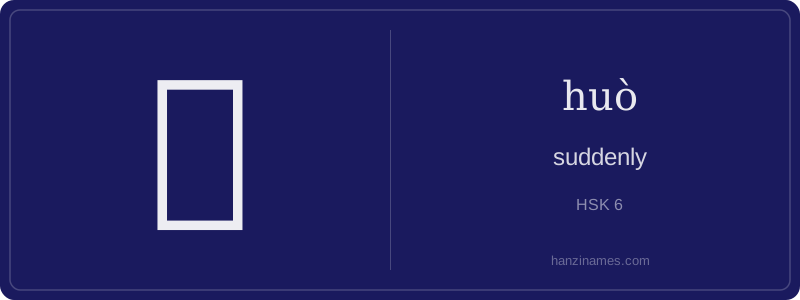
In modern Chinese, 霍 appears most frequently in fixed expressions emphasizing suddenness: 霍然 (huòrán, 'all at once'), 霍地 (huò dì, 'in a flash'), and the idiom 霍然而愈 (huò rán ér yù, 'to recover suddenly'). It’s documented in medical classics like the Huangdi Neijing, describing spontaneous symptom remission. The character also appears in surnames (e.g., the Han dynasty general Huò Qùbìng 霍去病), lending it historical resonance beyond abstraction.
The character’s form has no pictographic origin—it’s a phono-semantic compound. The top 雨 (yǔ, ‘rain’) is the semantic radical, hinting at atmospheric unpredictability; the bottom 雔 (a variant of 隹, zhī, ‘bird’) serves as the phonetic element, approximating huò. No oracle bone or bronze script forms survive, so its earliest attested use is in seal script from the Qin dynasty (3rd c. BCE), consistently conveying abrupt onset.
Imagine walking through Beijing’s Houhai Lake at dusk—suddenly, a gust of wind stirs the willow branches, ripples scatter across the water, and a flock of sparrows explodes skyward in unison. That instant, breath-catching shift? In Chinese, it’s 霍 (huò): not just ‘suddenly’, but a vivid, almost onomatopoeic flash of immediacy—like the rustle of rainclouds parting or a sword drawn in one smooth motion.
The character’s structure reinforces this sense of abruptness: its radical 雨 (rain) evokes atmospheric volatility, while the phonetic component 雔 (a variant of 隹, meaning ‘short-tailed bird’) suggests swift, darting movement. Historically, 霍 appears in classical texts like the Shuōwén Jiězì (121 CE) as a ‘sound of rapid motion’, used to describe sudden sounds or actions—not gradual change, but an event that interrupts time itself.
Though rare in isolation today, 霍 thrives in compound words and idioms where speed and surprise are central. It carries literary weight—think of martial arts novels where a master’s strike is described as 霍然出手 (huòrán chūshǒu, ‘suddenly launching an attack’). Its rarity makes it distinctive: learners at HSK 6 encounter it not as daily vocabulary, but as a marker of refined comprehension—like spotting a single crane amid a flock of pigeons.
Example Sentences
Common Compounds
Similar Characters — Don't Mix These Up
Your First Step into Chinese Culture: Get a Chinese Name
Every journey into Chinese begins with a name. Use our free Chinese name generator to create a meaningful, personalized Chinese name that fits you perfectly.
Get My Chinese Name →