霸
Character Story & Explanation
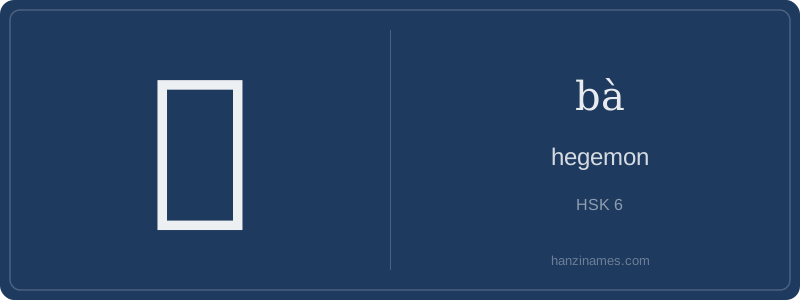
霸 appears prominently in historical texts like the Zuo Zhuan and Sima Qian’s Records of the Grand Historian, naming figures like Duke Huan of Qi—the first of the ‘Five Hegemons’ (春秋五霸). In modern Chinese, it’s used critically in phrases like 霸权主义 (bàquán zhǔyì, 'hegemonism') and widely in media to describe U.S. foreign policy or corporate monopolies. The term also appears in idioms such as 霸气十足 (bàqì shízú, 'exuding overwhelming charisma/authority').
The character’s structure combines 雨 (yǔ, 'rain', radical #173) at the top and 革 (gé, 'leather', 'reform') + 月 (yuè, 'moon', here acting phonetically) below. Though its oracle-bone origins are unclear, scholars agree 霸 emerged in bronze inscriptions during the late Western Zhou, originally linked to ritual authority over alliances—not rain. Today, Chinese learners most commonly encounter it in news headlines about international relations or tech competition (e.g., 'AI霸权').
霸 (bà) is a high-level HSK 6 character denoting 'hegemon'—a dominant power that exerts political, military, or economic control without formal sovereignty. Unlike 'emperor' (皇帝) or 'king' (王), 霸 implies supremacy through influence and coercion rather than legitimate mandate or ritual authority. Historically, it evokes the Spring and Autumn period’s 'Five Hegemons', regional lords who led coalitions under Zhou nominal rule.
In modern usage, 霸 carries strong connotations of unilateral dominance—often critical in geopolitical discourse. It parallels Western concepts like 'hegemony' (Gramsci) or 'Pax Americana', but with sharper moral ambiguity: while 'hegemon' in English can be neutral or descriptive, 霸 frequently implies overreach, arrogance, or unsustainable dominance—echoing Confucian disapproval of force over virtue (德).
Culturally, 霸 contrasts with 王 (wáng, 'king')—the ideal ruler who governs by moral authority—and 帝 (dì, 'emperor'), who holds cosmic legitimacy. This triad reflects China’s classical political philosophy: true leadership rests on virtue, not coercion. Thus, 霸 is neither purely negative nor celebratory; it’s a historically grounded term for de facto supremacy, often invoked to critique power imbalances in diplomacy, tech, or trade.
Example Sentences
Common Compounds
Similar Characters — Don't Mix These Up
Your First Step into Chinese Culture: Get a Chinese Name
Every journey into Chinese begins with a name. Use our free Chinese name generator to create a meaningful, personalized Chinese name that fits you perfectly.
Get My Chinese Name →