旁
Character Story & Explanation
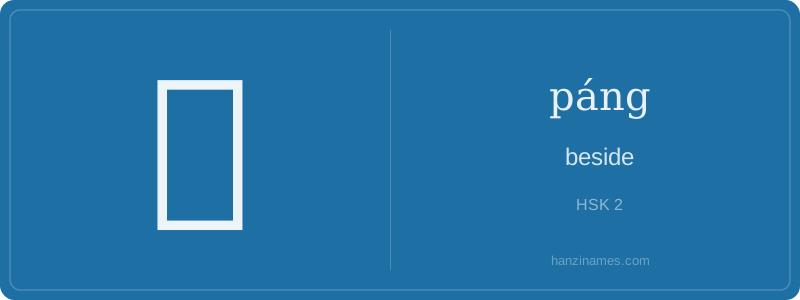
In daily life, 旁 is indispensable in directional instructions, education, and media. The phrase 旁边 (pángbiān, 'beside') is among the top 200 most frequently used two-character words in spoken Mandarin (based on COCA and BCC Corpus data). It appears in official signage (e.g., '请站在黄线旁' — 'Please stand beside the yellow line'), classroom language ('请坐到我旁边' — 'Please sit beside me'), and idioms like 旁若无人 (pángruòwúrén, 'as if no one were present'), documented since the Jin Dynasty (3rd–5th c. CE) in historical texts like Shishuo Xinyu.
The character’s form evolved from seal script, where 方 (fāng, 'square/region') served as semantic radical (indicating spatial domain), and 旁 itself was originally phonetic—though its ancient pronunciation diverged. No oracle-bone inscription of 旁 exists; earliest attestation is in Warring States bamboo slips (475–221 BCE), showing 方 + a phonetic component now lost in modern form. Today, learners encounter it first in HSK 2 vocabulary like 旁边 and 旁观 (bànguān, 'to observe from the side').
The Chinese character 旁 (páng) literally means 'one side' or 'beside'—a spatial concept indicating proximity or adjacency without direct contact. Unlike English prepositions like 'next to' or 'alongside', which often require articles or auxiliary words, 旁 functions as a versatile noun, adjective, or adverb in Chinese, commonly appearing in compound words and idioms. Its meaning is inherently relational, emphasizing position relative to a central point, much like the English word 'peripheral'—suggesting closeness but not centrality.
In contrast to Western dualistic spatial thinking (e.g., 'here vs. there'), 旁 reflects classical Chinese cosmology where relationships are defined by context and orientation rather than absolute coordinates. For example, in traditional architecture or ritual seating, 'left side' (左旁) and 'right side' (右旁) carry hierarchical significance—not merely physical location but social positioning. This relational nuance makes 旁 more culturally embedded than its English equivalents like 'side' or 'beside'.
Western equivalents such as 'adjacent', 'lateral', or 'peripheral' carry technical or abstract connotations, whereas 旁 remains grounded in everyday usage—from classroom seating ('sit beside me') to legal texts ('third-party observer'). It rarely appears alone in modern speech but thrives in compounds, echoing how English uses prefixes like 'para-' or 'peri-' (e.g., 'paranormal', 'perimeter')—yet 旁 feels more intuitive and less academic to native speakers, bridging concrete space and figurative distance.
Example Sentences
Common Compounds
Similar Characters — Don't Mix These Up
Your First Step into Chinese Culture: Get a Chinese Name
Every journey into Chinese begins with a name. Use our free Chinese name generator to create a meaningful, personalized Chinese name that fits you perfectly.
Get My Chinese Name →