鞠
Character Story & Explanation
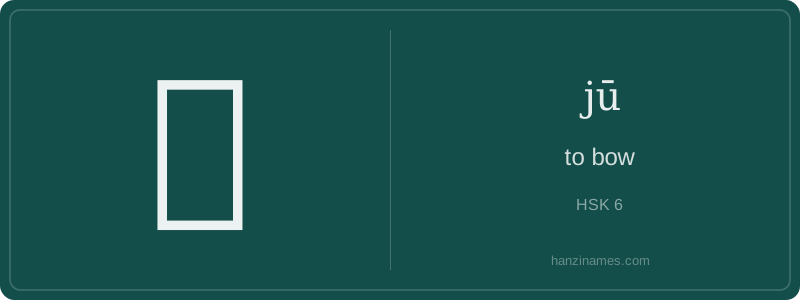
鞠 is most commonly used today in formal written expressions of respect: ‘鞠躬’ (jūgōng, 'to bow') appears in official speeches, memorial inscriptions, and etiquette guides. It features in the idiom ‘鞠躬尽瘁’ (jūgōng jìn cuì, 'to devote oneself utterly'), famously quoted by Zhuge Liang in his Chu Shi Biao (Memorial on Taking the Field, 227 CE)—a historically attested text preserved in the Records of the Three Kingdoms. This phrase remains widely cited in political and academic contexts to denote selfless service.
The character’s form is not pictographic but phono-semantic: the left radical 革 (gé, leather) hints at its original association with leather-bound ceremonial objects (e.g., ancient bowing mats), while the right component 菊 (jú, chrysanthemum) serves as a phonetic loan. No oracle bone or bronze script form survives; its earliest attestation is in Warring States bamboo slips (c. 4th century BCE), where it consistently means 'to bend forward respectfully'.
鞠 (jū) embodies a profound cultural gesture—not merely physical bending, but the conscious, respectful yielding of self to others, tradition, or circumstance. In Confucian ethics, bowing is not submission but affirmation: it acknowledges hierarchy, gratitude, and mutual dignity. The act of bowing—whether before elders, teachers, or ancestors—creates relational harmony (hé 和), reflecting the Chinese worldview where order emerges from mindful deference, not rigid authority.
This character reveals how language encodes philosophy: 鞠’s radical 革 (gé, 'leather; transformation') suggests that bowing reshapes the self—it is disciplined practice, not passive compliance. Historically, court rituals required precise degrees of bows (e.g., the nine-kowtow ceremony), each calibrated to status and intent. Thus, 鞠 is kinetic ethics—morality made visible through posture and motion.
In modern life, 鞠 retains solemnity in formal settings: diplomats bow during state visits, students bow at graduation ceremonies, and mourners bow three times at funerals. Even in digital communication, phrases like ‘鞠躬致谢’ appear in official emails—preserving ritual gravity in virtual space. This continuity shows how deeply embodied respect remains embedded in Chinese linguistic consciousness, bridging ancient rites and contemporary civility.
Example Sentences
Common Compounds
Similar Characters — Don't Mix These Up
Your First Step into Chinese Culture: Get a Chinese Name
Every journey into Chinese begins with a name. Use our free Chinese name generator to create a meaningful, personalized Chinese name that fits you perfectly.
Get My Chinese Name →