颇
Character Story & Explanation
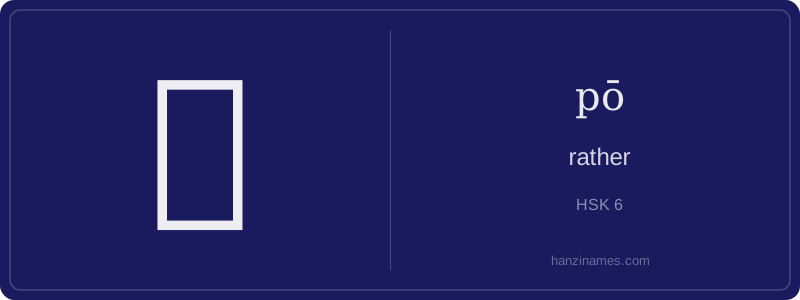
In modern Chinese, 颇 is primarily used in written or semi-formal speech to express moderate intensity — more emphatic than 很 (hěn, 'very') but less absolute than 极 (jí, 'extremely'). It appears in fixed phrases like 颇有见地 (pō yǒu jiàn dì, 'has considerable insight') and 颇负盛名 (pō fù shèng míng, 'is fairly renowned'), both documented in authoritative dictionaries like the Xiandai Hanyu Cidian. It’s rare in casual spoken Mandarin but common in news headlines, literary reviews, and historical documentaries.
The character’s origin is not pictographic but phono-semantic: 皮 (pí) originally served as a phonetic component, while 页 (yè) indicated a semantic link to the head — a theory supported by bronze script variants showing a head-like shape. No oracle bone form survives, but Shuowen Jiezi (121 CE) classifies it under 页, confirming its early association with cranial anatomy and, by extension, perception and judgment.
Our detective work begins with the radical 页 (yè), meaning 'page' or 'leaf', historically linked to the head or forehead in ancient bronze inscriptions. Though 颇 now means 'rather' or 'quite', its original form in early scripts combined 皮 (pí, 'skin') and 页 — suggesting a connection to the 'side of the head' or 'temporal region'. This anatomical nuance may have evolved metaphorically into notions of 'inclination' or 'bias', later softening to 'to some degree'.
By the Han dynasty, 颇 appears in texts like the Shiji (Records of the Grand Historian) as an adverb meaning 'rather' or 'somewhat', often modifying verbs or adjectives: e.g., '颇知之' ('knew it rather well'). Its grammatical role stabilized early — never a standalone noun or verb, always a degree adverb — distinguishing it from similar-sounding characters like 坡 (pō, 'slope') or 破 (pò, 'break').
The character’s 11-stroke structure follows a left-to-right, top-to-bottom logic: 皮 (4 strokes) on the left, 页 (6 strokes) on the right, with the final stroke completing the right-hand radical. Its HSK Level 6 status reflects not complexity of form, but subtlety of usage — it conveys measured emphasis, avoiding absolutes, and appears frequently in formal writing, academic discourse, and classical allusions, where precision in degree matters.
Example Sentences
Common Compounds
Similar Characters — Don't Mix These Up
Your First Step into Chinese Culture: Get a Chinese Name
Every journey into Chinese begins with a name. Use our free Chinese name generator to create a meaningful, personalized Chinese name that fits you perfectly.
Get My Chinese Name →