额
Character Story & Explanation
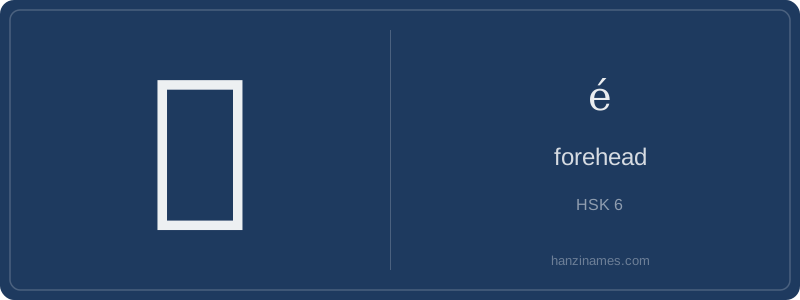
In daily life, 额 most commonly appears in formal and administrative language — especially in phrases like 额度 (édù, 'quota') and 超额 (chāo’é, 'excess amount'). It’s ubiquitous on Chinese bank statements, government notices, and workplace KPI documents. Historically, the character appears in Song dynasty texts referring to official fiscal quotas, and by the Ming-Qing era, 额度 was standard terminology in tax administration. A well-documented idiom is 额手称庆 (é shǒu chēng qìng), meaning 'to clasp one’s hands before the forehead in celebration' — still used in formal writing to express collective relief or joy.
The character’s form combines the 页 (yè) radical — originally a pictograph of a person’s head with prominent features — and 客 (kè, 'guest') as a phonetic component. While 页 evolved from oracle-bone script depicting a head with eyes and hair, its modern shape no longer resembles that image; instead, it functions as a reliable semantic classifier for head-related terms. Today, Chinese learners encounter 额 most often in written contexts, not spoken conversation.
The Chinese character 额 (é) literally means 'forehead' — the smooth, prominent area above the eyebrows and below the hairline. In traditional Chinese medicine and physiognomy, the forehead is considered a vital indicator of health, vitality, and even destiny. Its radical 页 (yè), meaning 'leaf' or 'page', originally depicted the head in ancient scripts and now serves as a semantic marker for head-related characters like 顶 (dǐng, top of head) and 顷 (qǐng, a moment — historically linked to head movement).
While 额 is rarely used alone in modern speech, it appears consistently in compound words and idiomatic expressions. Its tone is rising (second tone), and its pronunciation requires careful lip rounding after the initial 'e' — similar to the 'ay' in 'say', but shorter and higher-pitched. Learners often confuse it with 峨 (é, 'lofty mountain'), which shares the same sound but different radical and meaning.
At HSK Level 6, 额 signals advanced lexical competence: users must recognize it not just anatomically, but functionally — as a component in bureaucratic terms like 额度 (édù, 'quota') or financial contexts like 超额 (chāo’é, 'exceeding the quota'). This semantic extension from 'forehead' to 'preset upper limit' reflects classical metaphorical usage: just as the forehead marks the upper boundary of the face, 额 came to denote a fixed upper threshold in measurement or allocation.
Example Sentences
Common Compounds
Similar Characters — Don't Mix These Up
Your First Step into Chinese Culture: Get a Chinese Name
Every journey into Chinese begins with a name. Use our free Chinese name generator to create a meaningful, personalized Chinese name that fits you perfectly.
Get My Chinese Name →