馅
Character Story & Explanation
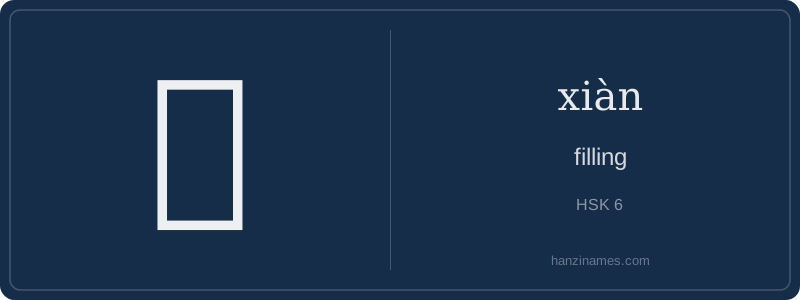
In daily life, 馅 appears ubiquitously on food labels (e.g., ‘牛肉馅’ – beef filling), restaurant menus, and cooking shows. It’s central to idioms like ‘有馅儿的包子’ (a metaphor for something seemingly ordinary but containing hidden value). Historically documented since the Song dynasty, 馅 features in Yuan-era culinary manuals describing ‘meat-stuffed steamed buns’—confirming its long-standing role in Chinese gastronomy.
The character is not pictographic but a semantic-phonetic compound: left radical 饣 signals food-related meaning; right component 陷 (xiàn) provides pronunciation and subtly conveys ‘sinking in’—reflecting how fillings settle *inside* dough. No oracle-bone origin exists; its earliest attested form appears in Ming dynasty dictionaries as a standardized food term.
Imagine stepping into a bustling Beijing hutong at dawn—steam rises from bamboo baskets stacked high outside a century-old dumpling shop. Inside, Auntie Li deftly folds jiaozi, her fingers pressing pleats around savory mixtures of pork, chives, and ginger: the ‘xiàn’. This character isn’t just linguistic—it’s tactile, aromatic, cultural. 馅 (xiàn) names the heart of countless Chinese foods: what makes baozi soft and rich, mooncakes sweet and dense, and zongzi fragrant with glutinous rice and dates.
The radical 饣 (‘food’ or ‘eat’) anchors it firmly in sustenance, while the right side 陷 (xiàn, ‘to sink’ or ‘trap’) hints at how fillings nestle *within*, concealed yet essential—like secrets held inside dough. At HSK 6, it appears in advanced culinary texts, food packaging labels, and even metaphors: ‘a trap hidden in sweet words’ uses the same phonetic-semantic compound structure.
Unlike abstract nouns, 馅 is deeply embodied: children learn it by kneading dough; chefs debate optimal fat-to-meat ratios for ‘perfect xiàn’; elders recall wartime ‘sweet potato xiàn’ during scarcity. Its 11 strokes mirror the care required to prepare it—neither rushed nor superficial. To know 馅 is to understand how Chinese culture values inner substance over outer form—what’s hidden defines what’s whole.
Example Sentences
Common Compounds
Similar Characters — Don't Mix These Up
Your First Step into Chinese Culture: Get a Chinese Name
Every journey into Chinese begins with a name. Use our free Chinese name generator to create a meaningful, personalized Chinese name that fits you perfectly.
Get My Chinese Name →