驳
Character Story & Explanation
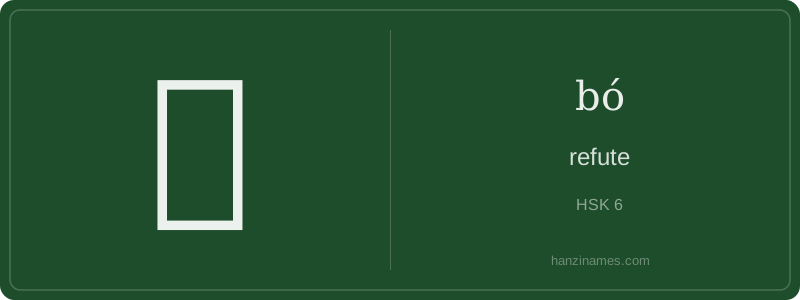
In contemporary Chinese, 驳 is most frequently encountered in formal and academic contexts—not as 'variegated' (its archaic meaning), but as a verb meaning 'to refute' or 'to rebut', especially in written discourse. It appears in official documents, legal arguments, and scholarly debates: e.g., 驳回 (bóhuí, 'to reject [a motion]'), 驳斥 (bóchì, 'to denounce/refute forcefully'). A well-known idiom is 驳倒对方论点 (bó dǎo duìfāng lùndiǎn, 'to dismantle the opponent’s argument'). Its use signals intellectual rigor and precision.
The character’s form combines the 'horse' radical (马) with 勹 (bāo, a wrapping enclosure) and 冖 (mì, a covering), reflecting its earliest documented meaning in the Shuōwén Jiězì (121 CE): a dappled or piebald horse—visually variegated. No oracle-bone inscriptions survive for 马-related characters before the late Shang, but bronze inscriptions confirm 驳 described equine coat patterns. The 'horse + pattern' composition is literal and attested.
The character 驳 (bó) opens a window into the Chinese worldview that values layered complexity over monolithic uniformity. Though its basic meaning is 'variegated'—referring to mixed colors, patterns, or textures—it embodies a deeper philosophical stance: truth and beauty often reside in heterogeneity, not homogeneity. In classical thought, this resonates with Daoist appreciation for natural diversity and Confucian recognition of multifaceted human roles. The very idea of 'variegation' implies coexistence without erasure—colors distinct yet harmonized, like ink wash painting where graded tones suggest depth without sharp borders.
Historically, 驳 appears in early texts describing hybrid animals—most notably the 'bó horse' (驳马), a mythical steed with dappled coat said to devour tigers. This imagery links variegation with protective power and liminality: the ability to straddle realms (wild/domestic, danger/safety). Such symbolism reflects a cultural comfort with paradox and synthesis—where difference isn’t disorder but an active, generative force. The character thus encodes an aesthetic and ethical preference for richness-in-variety.
Today, 驳 continues to evoke textured authenticity. In modern usage, it subtly critiques oversimplification—whether in political rhetoric, educational models, or environmental policy—by reminding speakers that healthy systems thrive on diversity. Its presence in compounds like 驳斥 (bóchì, 'to refute') carries this same logic: refutation isn’t destruction, but the careful untangling of flawed reasoning to reveal a more nuanced truth. In this way, 驳 is both descriptive and prescriptive—a linguistic vessel for China’s enduring embrace of multiplicity as a condition of integrity.
Example Sentences
Common Compounds
Similar Characters — Don't Mix These Up
Your First Step into Chinese Culture: Get a Chinese Name
Every journey into Chinese begins with a name. Use our free Chinese name generator to create a meaningful, personalized Chinese name that fits you perfectly.
Get My Chinese Name →