魂
Character Story & Explanation
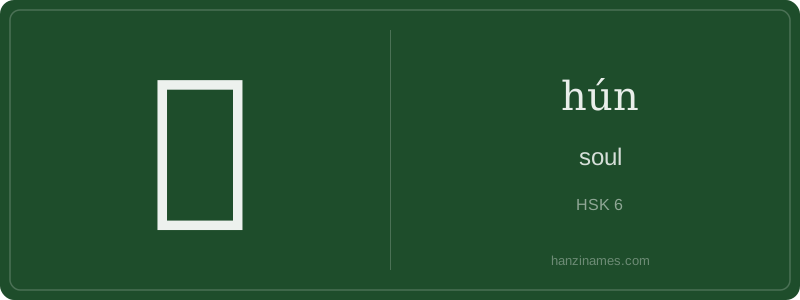
In daily modern Chinese, 魂 most commonly appears in fixed phrases and literary language. It’s central to idioms like 魂牵梦萦 (hún qiān mèng yíng, 'soul-tethered, dream-lingering'), expressing deep, unshakable longing — often for hometown or lost love. Historically, the Zuo Zhuan (c. 4th century BCE) references 'three hun and seven po' souls in ritual contexts, and Tang dynasty poetry frequently uses 魂 to evoke melancholy or transcendence. You’ll also see it in names (e.g., the famous poet Li He was nicknamed ‘Ghost Poet’ — 诗鬼), reflecting cultural associations with otherworldly inspiration.
The character evolved from seal script, where 鬼 depicted a kneeling figure with a large head (suggesting spiritual presence), and 云 was added later for sound. No oracle bone form survives — its earliest attested use is in Warring States bamboo slips. Today, Chinese people use 魂 in heartfelt expressions like '丢了魂儿' (diū le húnr, 'lost one’s soul') — meaning stunned, dazed, or deeply distracted — a vivid, colloquial usage confirmed in contemporary dictionaries like the Xiandai Hanyu Cidian.
Hi students! The character 魂 (hún) means 'soul' or 'spirit' — not the physical body, but the invisible, enduring essence of a person. In Chinese philosophy and folklore, it’s believed that after death, the soul may journey to the afterlife, linger as a ghost (ghost = 鬼, the radical of 魂), or be reborn. This idea appears in ancient texts like the Chu Ci (Songs of Chu) and Daoist funerary rites. Understanding 魂 helps you grasp deeper cultural concepts like respect for ancestors and the balance between life and death.
Notice its radical: 鬼 (guǐ), meaning 'ghost' — it tells us this character is about non-corporeal, spiritual existence. The right side, 云 (yún), originally meant 'cloud' and here serves as a phonetic hint (though pronunciation has shifted from ancient times). Don’t confuse it with 魄 (pò), the 'earthly soul' tied to breath and bodily functions — together, 魂 and 魄 form the dual-soul theory in traditional Chinese thought.
At HSK Level 6, 魂 appears in literary, philosophical, and emotional contexts — not everyday small talk, but in expressions like '魂飞魄散' (hún fēi pò sàn, 'soul flies, spirit scatters') meaning extreme shock. It’s also used metaphorically: '诗魂' (shī hún, 'the soul of poetry') describes a poem’s profound emotional core. Practice writing it slowly: 13 strokes, starting with the 鬼 radical on the left — pay attention to the dot above the 'ghost' head and the curved stroke in 云.
Example Sentences
Common Compounds
Similar Characters — Don't Mix These Up
Your First Step into Chinese Culture: Get a Chinese Name
Every journey into Chinese begins with a name. Use our free Chinese name generator to create a meaningful, personalized Chinese name that fits you perfectly.
Get My Chinese Name →