鸦
Character Story & Explanation
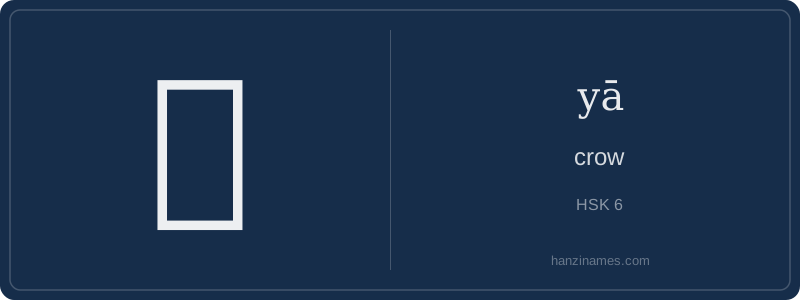
In modern Chinese, 鸦 appears most frequently in literary, idiomatic, and ecological contexts—not daily casual speech. The idiom '鸦雀无声' (yā què wú shēng, 'not even a crow or sparrow makes a sound') is widely taught and used to describe absolute silence, especially in classrooms or formal settings. Historically, 鸦 featured in Song dynasty naturalist texts like Bencao Tujing (Illustrated Classic of Materia Medica), where crow feathers and bile were documented for traditional remedies.
The character’s form is not pictographic—it evolved as a phono-semantic compound. Left side 牙 (yá) originally provided sound approximation; right side 鸟 (niǎo) signals avian category. No oracle bone version exists; earliest confirmed usage is in Han-era bamboo slips and stele inscriptions, confirming its late emergence among bird-related characters.
As a linguistic detective, I begin with the oracle bone and bronze inscriptions—but here, the trail goes cold: 鸦 has no verified pre-Qin forms. It first appears in seal script (c. 3rd century BCE) as a compound of 牙 (yá, 'fang/tooth', phonetic) and 鸟 (niǎo, 'bird', semantic). This is classic phono-semantic construction: the radical tells us it’s avian; the phonetic hints at pronunciation—though modern yā diverges from ancient *ŋrɑj (reconstructed Old Chinese for 牙).
The character stabilizes in clerical script during the Han dynasty, with 鸟 shrinking to its modern ‘bird’ form on the right and 牙 simplifying leftward. By the Tang, 鸦 is fully standardized—no longer pictographic, but deeply functional: it names a real bird, carries literary weight, and avoids confusion with other corvids like 乌 (wū, 'raven') or 鹊 (què, 'magpie'). Its nine strokes encode taxonomy, not imagery.
Why not just use 乌? Because 鸦 specifically denotes the large, glossy, often raucous crow (Corvus macrorhynchos), culturally associated with dusk, omen, and urban resilience. Its creation filled a lexical gap: 乌 is older and more poetic/ambiguous; 鸦 is precise, zoological, and pragmatic—born not from myth, but from the need to distinguish species in texts like medicinal manuals and local gazetteers.
Example Sentences
Common Compounds
Similar Characters — Don't Mix These Up
Your First Step into Chinese Culture: Get a Chinese Name
Every journey into Chinese begins with a name. Use our free Chinese name generator to create a meaningful, personalized Chinese name that fits you perfectly.
Get My Chinese Name →