鳤
Character Story & Explanation
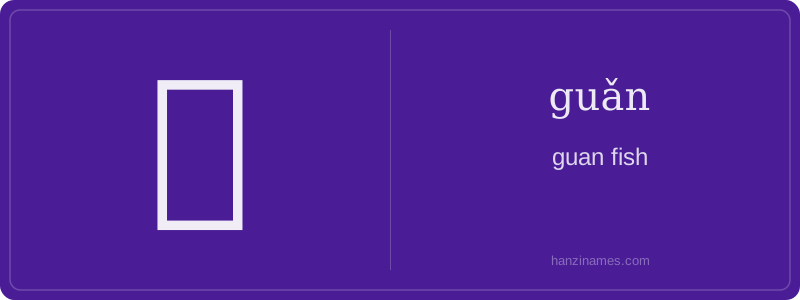
鳤 is virtually absent from daily spoken or written Mandarin. It appears almost exclusively in ichthyological literature, government conservation documents (e.g., China’s List of Endangered Wild Animals), and regional fisheries reports — notably in Yangtze River basin studies since the 1980s. No idioms, proverbs, or literary allusions containing 鳤 are recorded in authoritative corpora (e.g., CCL, BCC). Its usage is strictly technical and scientific.
The character is a phono-semantic compound: left radical 魚 (yú, ‘fish’) indicates category; right component 管 (guǎn, ‘pipe’, ‘to manage’) provides pronunciation. This follows standard Chinese character formation rules documented in the Shuōwén Jiězì (121 CE), where phonetic loans were systematically applied to name newly classified species. No oracle bone or bronze script forms exist — it emerged later, likely during the Ming–Qing period, as taxonomic precision increased.
The character 鳤 (guǎn) is a rare, highly specialized logograph denoting a single biological species — Ochetobius elongatus — a slender, migratory cyprinid fish native to the Yangtze River basin and other eastern Asian waterways. Its existence in writing reflects the Chinese tradition of precise nomenclature for local fauna, especially species with ecological or historical significance. Unlike common characters shaped by daily use, 鳤 embodies scientific taxonomy embedded in script — a quiet testament to how Chinese writing accommodates biodiversity knowledge long before modern biology.
This character reveals a worldview where language mirrors ecological attentiveness: naming a fish isn’t poetic metaphor but an act of stewardship. In classical texts and regional fishery records, such precise terms supported sustainable practices — distinguishing spawning migrants like 鳤 from similar species was vital for seasonal bans and river management. Its rarity today underscores shifting human relationships with rivers: as the Yangtze’s flow changed and dams rose, 鳤 declined — and so did the frequency of its written appearance, making the character itself an archival trace of environmental memory.
Unlike ideograms for universal concepts (e.g., 仁 ‘benevolence’ or 道 ‘the Way’), 鳤 resists abstraction. It points unambiguously to a creature — one with silver scales, a pointed snout, and a life cycle tied to monsoon floods and sediment-rich currents. To encounter 鳤 on paper is to glimpse a hydrological worldview: language anchored not just in land, but in water’s rhythm, seasonal pulse, and interdependence. Its very structure — combining ‘fish’ (魚) with ‘guǎn’ (a phonetic component) — enacts this fusion: meaning flows from both semantic clarity and phonetic specificity, much like a river carrying both silt and song.
Example Sentences
Common Compounds
Similar Characters — Don't Mix These Up
Your First Step into Chinese Culture: Get a Chinese Name
Every journey into Chinese begins with a name. Use our free Chinese name generator to create a meaningful, personalized Chinese name that fits you perfectly.
Get My Chinese Name →