丂
Character Story & Explanation
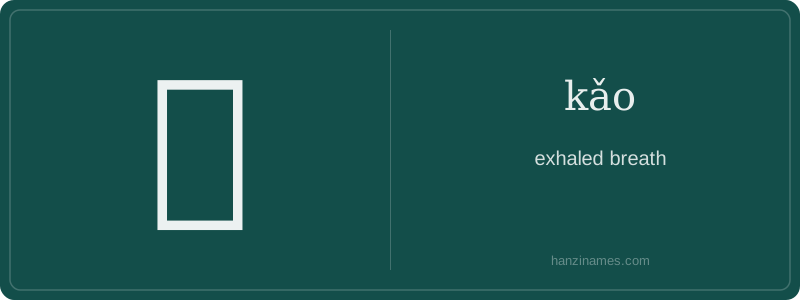
丂 (kǎo) does not appear in any modern HSK word list, dictionary entry, or contemporary idiom—it is functionally obsolete as an independent or standalone character. Its only documented usage is as a historical component in seal script and bronze inscriptions, notably in the early form of 可 (kě, 'can; may'). The Shuōwén Jiězì explicitly lists 丂 as a separate head entry, defining it as 'the sound of breath escaping' (氣出也), confirming its phonosemantic role in breath-related morphemes.
The character’s form—a horizontal stroke followed by a rightward-curving hook—is not pictographic of a physical object, but rather a stylized representation of exhalation: the first stroke suggests inhalation or stillness (the radical 一), and the second mimics breath flowing out and downward. Today, Chinese calligraphers and paleographers recognize it only in academic contexts—never in signage, media, or education.
The character 丂 (kǎo) is a rare, archaic component—not used independently in modern Chinese—but historically significant as a phonetic or semantic element related to breath, exhalation, or sighing. It appears in ancient bronze inscriptions and early dictionaries like the Shuōwén Jiězì (c. 100 CE), where it’s defined as 'the sound of breath escaping'—a subtle, almost onomatopoeic trace of human respiration in script.
Though visually minimal—just two strokes (horizontal then downward-right hook)—its form evokes an exhaled breath curling outward. Unlike common radicals like 心 (heart) or 口 (mouth), 丂 belongs to a small class of 'breath-related' components that subtly shape characters involving voice, effort, or emotional release—such as 可 (kě, 'can'), which historically incorporated 丂 as its upper element before standardization.
This character exemplifies how Chinese writing encodes physiological experience: not just objects or actions, but internal states like sighing, panting, or relief. While no longer active in daily vocabulary, 丂 survives in scholarly analysis of character evolution and paleography—offering linguists a quiet window into how early Chinese scribes mapped bodily sensation onto ink and bamboo.
Example Sentences
Common Compounds
Similar Characters — Don't Mix These Up
Your First Step into Chinese Culture: Get a Chinese Name
Every journey into Chinese begins with a name. Use our free Chinese name generator to create a meaningful, personalized Chinese name that fits you perfectly.
Get My Chinese Name →