丨
Character Story & Explanation
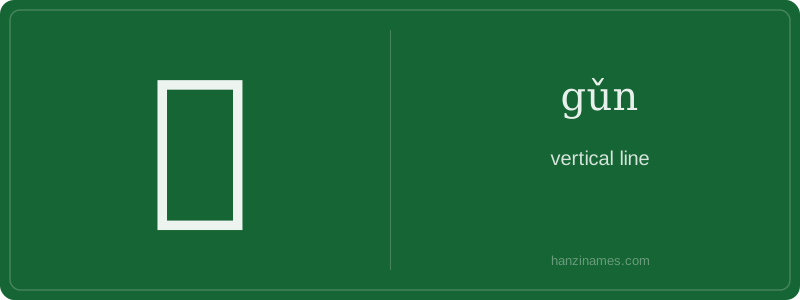
In contemporary Chinese, 丨 is never used alone in texts, speech, or digital communication. It appears solely in dictionary indexes, Unicode charts (U+4E26), and character decomposition tools as Radical 2. You’ll find it listed in the Kangxi Dictionary and modern resources like the Xinhua Zidian under 'radicals', but never in idioms, slogans, or literature. Its presence is purely meta-linguistic—helping learners and lexicographers classify characters like 串 (chuàn, 'skewer') or 临 (lín, 'to approach'), where the vertical line forms part of the structure.
This character originated as a simple pictographic stroke representing a straight vertical line—no oracle-bone or bronze inscription evidence suggests symbolic meaning. Its form has remained unchanged for over two millennia. Today, Chinese students encounter it only when learning radical lookup methods or stroke-order rules, not vocabulary.
The character 丨 (gǔn) is a rare, single-stroke vertical line that functions exclusively as a radical—not as an independent word in modern usage. Though it appears in dictionaries with the pronunciation gǔn, this reading is largely archaic and technical; in practice, it’s almost never spoken aloud. Its primary role is structural: it serves as the 'vertical line' radical (Radical 2) in characters like 中 (zhōng, 'middle') and 丰 (fēng, 'abundant'), where it anchors the vertical axis of the glyph.
Unlike most Chinese characters, 丨 has no semantic or phonetic content on its own—it conveys no meaning like 'person', 'water', or 'fire'. Instead, it belongs to a small group of 'pure form radicals' used solely for indexing and classification in dictionaries and character analysis. Its simplicity—just one downward stroke—makes it foundational for stroke-order pedagogy, yet it remains invisible in daily speech and writing.
Comparatively, Western writing systems lack direct equivalents: Latin letters are phonemic units, not structural radicals. The closest analogues are typographic or grammatical markers—like the vertical bar '|' in programming (pipe operator) or linguistics (syllable boundary), or the central stem in serif fonts (e.g., the 'stem' of 'd' or 'h'). But unlike those, 丨 carries no functional syntax—it exists only as a categorization tool in Chinese lexicography and calligraphy pedagogy.
Example Sentences
Common Compounds
Similar Characters — Don't Mix These Up
Your First Step into Chinese Culture: Get a Chinese Name
Every journey into Chinese begins with a name. Use our free Chinese name generator to create a meaningful, personalized Chinese name that fits you perfectly.
Get My Chinese Name →