丿
Character Story & Explanation
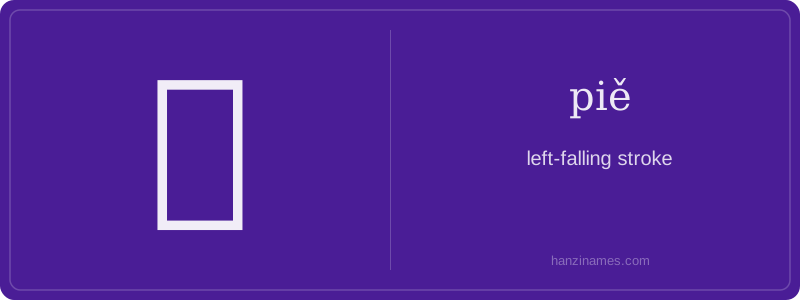
In daily life, 丿 is never spoken or written independently—it appears exclusively as the first stroke in hundreds of characters (e.g., 人, 九, 义). Chinese learners recite stroke names aloud during writing practice: 'piě, nà, zhé...'—a ritual embedded in every HSK handwriting exercise. It features in pedagogical tools like the 'Eight Principles of Yong' (永字八法), where piě is the second stroke in 永 (yǒng), symbolizing disciplined brush control. No idioms or proverbs use 丿 alone; its presence is strictly orthographic and instructional.
The form of 丿 originates not from a pictograph, but from the natural motion of early brushwork: a quick, downward-leftward pull of the wrist to initiate many characters. Archaeological evidence from Warring States bamboo slips shows consistent use of this stroke shape as a structural element—not a glyph representing an object, but a kinetic signature of writing itself.
As a detective tracing the evolution of 丿, I begin at the crime scene of early Chinese script: the oracle bone and bronze inscriptions. Here, 丿 doesn’t appear as an independent character—but rather as a deliberate, swift left-falling stroke carved into bone or cast in bronze. It wasn’t a word, but a *gesture*: the scribe’s first decisive flick of the brush or chisel—lean, unbroken, descending from top-right to bottom-left. This motion would later crystallize into a formalized component, not for meaning, but for structure.
Zooming in on the Han dynasty, I find 丿 formally codified in the Shuōwén Jiězì (121 CE)—China’s first systematic dictionary—as Radical #4, labeled 撇 (piě), meaning 'to flick away' or 'to brush aside'. Xu Shen didn’t treat it as a lexical unit but as one of 540 structural keys organizing all characters. Its 'meaning' was procedural: a directional stroke essential to writing, like the downstroke in 't' or the crossbar in 'H' in English typography—functional, not semantic.
Modern forensics confirm: 丿 has never been used alone in classical texts, modern literature, or official documents as a standalone word. No dictionary lists it with lexical definitions like 'person' or 'water'. Its identity is purely orthographic—it’s the DNA strand that shapes characters like 人 (rén, person), 入 (rù, to enter), and 乂 (yì, to govern). Even today, calligraphers invoke its name—piě—only when teaching stroke order, never when reading aloud. It’s grammar made visible: silent, indispensable, and utterly foundational.
Example Sentences
Common Compounds
Similar Characters — Don't Mix These Up
Your First Step into Chinese Culture: Get a Chinese Name
Every journey into Chinese begins with a name. Use our free Chinese name generator to create a meaningful, personalized Chinese name that fits you perfectly.
Get My Chinese Name →