乇
Character Story & Explanation
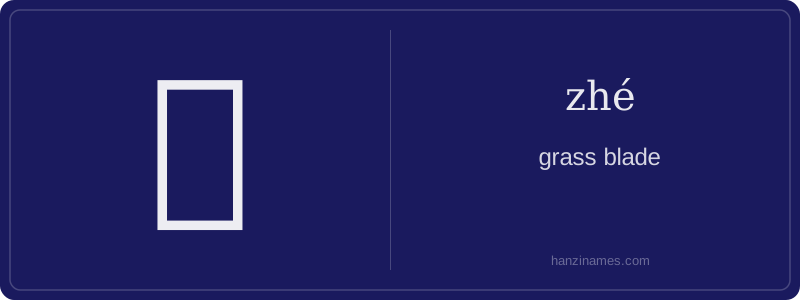
乇 (zhé) does not appear independently in modern Mandarin vocabulary, nor is it found in any HSK-level words, idioms, or contemporary phrases. It has no usage in daily speech or writing. According to authoritative sources—including the Xiandai Hanyu Cidian (7th ed.) and the Kangxi Zidian—it is listed only as a rare variant form of the grass radical (艹), occasionally seen in pre-Qin bronze inscriptions and Han dynasty clerical script as a simplified depiction of grass or sprouting vegetation.
The character originates as a pictographic simplification: the 丿 represents a central stem, and the two horizontal strokes symbolize paired leaves or blades—a minimal visual representation of a single grass shoot. While not used today as a word, calligraphers and paleographers recognize it as part of the evolutionary lineage of plant-related characters.
Hello, learners! Today we’re exploring 乇 (zhé), a tiny but meaningful character with just three strokes. Though rarely used alone in modern Chinese, it’s an essential component—especially as a variant form of the ‘grass’ or ‘plant’ radical (艹) in older or stylistic writing. Think of it as a minimalist grass blade: one stroke for the stem (丿), then two short horizontal lines representing leaves. It’s not a standalone word you’ll use daily, but recognizing it helps you decode many plant-related characters.
This character is classified under the 丿 (piě) radical—the ‘left-falling stroke’—which makes sense because its first stroke is exactly that. Its stroke order is simple: 1) left-falling stroke (丿), 2) top horizontal (一), 3) bottom horizontal (一). While it looks like a simplified 艸 (cǎo, 'grass'), 乇 is not a full character in standard dictionaries like the Kangxi Dictionary—it appears mainly as a component in historical texts, calligraphy, or variant forms of characters like 芍 (sháo, peony) or 苞 (bāo, bud).
Don’t confuse 乇 with more common radicals like 艹 (cǎo zì tóu)—the standard grass radical seen atop characters like 花 (huā, flower) or 草 (cǎo, grass). 乇 is rarer and more archaic, often appearing in seal script or handwritten variants. Still, studying it deepens your understanding of how Chinese characters evolved: from pictographic representations of nature (like grass) to stylized, abstract components. It’s a quiet reminder that every stroke carries history—even the smallest ones!
Example Sentences
Common Compounds
Similar Characters — Don't Mix These Up
Your First Step into Chinese Culture: Get a Chinese Name
Every journey into Chinese begins with a name. Use our free Chinese name generator to create a meaningful, personalized Chinese name that fits you perfectly.
Get My Chinese Name →