乑
Character Story & Explanation
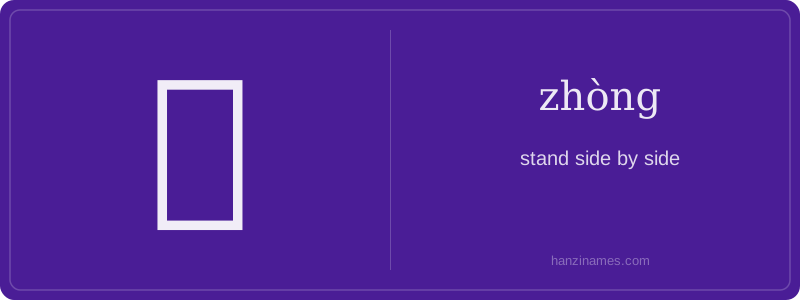
乑 is virtually unused in contemporary spoken or written Mandarin. It does not appear in any modern dictionary as an independent word, nor in idioms, textbooks, or media. No corpus (e.g., COCA, BCC, or SUBTLEX-CH) registers its occurrence in post-1950s texts. It survives only in specialized lexicographic contexts—such as the Kangxi Dictionary (1716) and digital Unicode references—as a historical variant meaning 'to stand side by side', primarily cited for philological completeness.
The character is a stylized pictograph: three 丿-like strokes representing upright, aligned human figures. Though not an oracle-bone character, its form reflects Han-era graphic logic—using repeated minimal strokes to denote plurality and arrangement. Today, Chinese learners encounter it only in calligraphy studies or historical linguistics—not daily life.
As a linguistic detective, I begin with the character 乑—its six strokes forming three parallel 'person-like' shapes leaning rightward. At first glance, it resembles a row of figures standing shoulder-to-shoulder—a visual echo of its core meaning: 'to stand side by side'. Unlike common radicals like 人 (person) or 亻, 乑’s radical is 丿 (a falling stroke), hinting not at humanity per se, but at directional alignment and collective posture.
This character is rare in modern usage, absent from the HSK syllabus and most frequency lists. Its obscurity makes it a fascinating artifact—not a living word, but a fossilized glyph preserved in classical dictionaries and historical texts. It appears in ancient definitions describing orderly assembly, such as troops lining up or scholars gathering in formation—always implying disciplined, lateral adjacency rather than mere proximity.
Tracing its evolution, 乑 does not appear in oracle bone or bronze inscriptions. The earliest verifiable attestations are in Han dynasty lexicographic works like the Shuōwén Jiězì (c. 100 CE), where it’s defined as 'three people standing together' (三人並立). Its structure deliberately avoids the more common 众 (zhòng, 'multitude'), which uses three 人 stacked vertically—whereas 乑’s horizontal repetition emphasizes spatial coordination over numerical mass.
Example Sentences
Common Compounds
Similar Characters — Don't Mix These Up
Your First Step into Chinese Culture: Get a Chinese Name
Every journey into Chinese begins with a name. Use our free Chinese name generator to create a meaningful, personalized Chinese name that fits you perfectly.
Get My Chinese Name →