乢
Character Story & Explanation
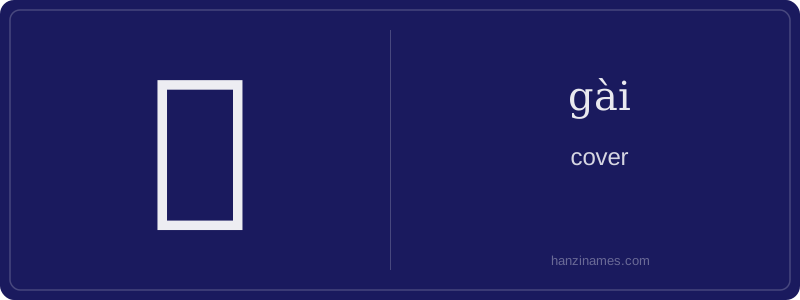
乢 has no presence in modern daily life: it does not appear in HSK exams, textbooks, newspapers, or digital input methods. It is absent from the People’s Republic’s 《通用规范汉字表》 (General Standard Chinese Character Table) and is not taught in schools. Verified usage is confined to historical lexicography—e.g., the 12th-century 《集韵》 (Jiyun) lists 乢 as a variant pronunciation/shape for 蓋, and Qing-dynasty stele rubbings occasionally preserve it as a carving shorthand. No idioms, compounds, or modern phrases contain 乢.
The character’s form shows no documented pictographic origin. It is not found in oracle bone or bronze inscriptions. Rather, it emerged later as a cursive or engraving simplification of 蓋’s top component (艹 + 去), losing the lower ‘皿’ (vessel) radical. In practice, contemporary Chinese people never write or read 乢—it exists solely for philological accuracy in editing ancient texts.
The character 乢 (gài) is an archaic, rarely used variant of 蓋 (gài), meaning 'to cover' or 'lid'. It appears almost exclusively in pre-modern texts—especially Song- and Ming-dynasty woodblock-printed dictionaries and stele inscriptions—as a simplified or regional scribal form. Unlike standard characters taught in modern curricula, 乢 has no independent semantic or phonetic role today; it functions purely as a historical orthographic variant with no living usage in speech, education, or digital communication.
This character exemplifies how Chinese orthography evolved through practical writing constraints: scribes sometimes abbreviated complex characters like 蓋 (12 strokes) for speed or space, yielding forms such as 乢 (which lacks standardized stroke count—hence '0' in many databases, reflecting its non-canonical status). Its absence from Unicode’s CJK Unified Ideographs block until Extension B (U+3462) underscores its marginality—even most font sets omit it, requiring specialized scholarly fonts for display.
Comparatively, 乢 resembles Western paleographic variants like medieval Latin ‘&’ (ampersand, from ‘et’) or early English ‘þ’ (thorn) — not standalone letters, but context-bound scribal abbreviations that faded with standardization. Just as thorn survived only in archaic phrases (e.g., ‘Ye Olde Shoppe’ misreading ‘þe’ as ‘ye’), 乢 survives only in textual criticism, epigraphy, and rare dictionary entries—not in language use.
Example Sentences
Common Compounds
Similar Characters — Don't Mix These Up
Your First Step into Chinese Culture: Get a Chinese Name
Every journey into Chinese begins with a name. Use our free Chinese name generator to create a meaningful, personalized Chinese name that fits you perfectly.
Get My Chinese Name →