乪
Character Story & Explanation
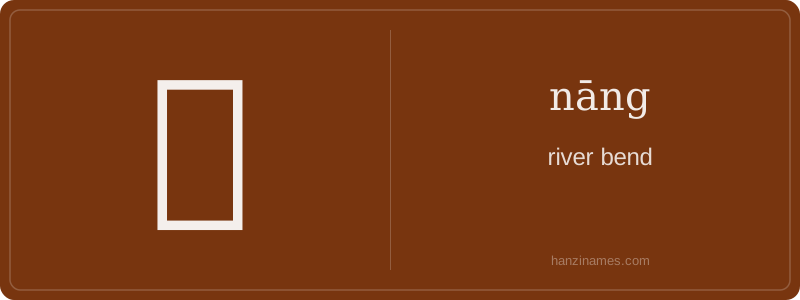
乪 (nāng) appears almost exclusively in historical and modern Cantonese and Minnan toponyms—for example, in village names like 乪頭 (Nāng Tàuh, 'Bend Head') in Hong Kong’s New Territories and Guangdong’s Pearl River Delta. It is documented in Qing-dynasty gazetteers and still used on official Hong Kong maps and rural land records. No standard idiom or literary phrase contains it; its function remains strictly geographical and local.
The character is not found in oracle bone or bronze inscriptions and lacks a canonical etymological origin. Its form—a smooth, downward-curving stroke—visually mimics a river’s arc. Today, it appears mainly on bilingual Hong Kong street signs, heritage trail markers, and local history publications, where Cantonese speakers recognize it instantly as 'that bend in the creek near the old temple'.
The character 乪 (nāng) is a rare, regionally preserved glyph representing a gentle river bend—a subtle yet profound embodiment of the Chinese worldview that sees nature’s curves not as deviations, but as harmonious, life-sustaining forms. In classical geography and feng shui thought, such bends slow water flow, enrich soil, and shelter settlements—making them auspicious features worthy of naming. This reflects a core Daoist and Confucian sensibility: wisdom lies in following natural contours rather than imposing straight-line control.
Unlike characters for ‘river’ (河, hé) or ‘water’ (水, shuǐ), 乪 carries no abstract moral weight—it is purely topographic, almost onomatopoeic in shape. Its flowing, sinuous form visually echoes the meander it denotes, inviting the reader to *see* the landscape before reading its name. This exemplifies how early Chinese writing often emerged from direct observation: not just labeling things, but encoding their essence through line and rhythm.
In modern usage, 乪 stands as a quiet testament to linguistic biodiversity—preserved in place names across Guangdong and Fujian, where dialectal cartography resisted standardization. Its survival signals cultural resilience: even as Mandarin homogenizes vocabulary, local communities retain lexical anchors to ancestral terrain. To encounter 乪 is to glimpse how language, land, and livelihood intertwine—where a single curve on paper maps centuries of lived relationship with rivers.
Example Sentences
Common Compounds
Similar Characters — Don't Mix These Up
Your First Step into Chinese Culture: Get a Chinese Name
Every journey into Chinese begins with a name. Use our free Chinese name generator to create a meaningful, personalized Chinese name that fits you perfectly.
Get My Chinese Name →