亅
Character Story & Explanation
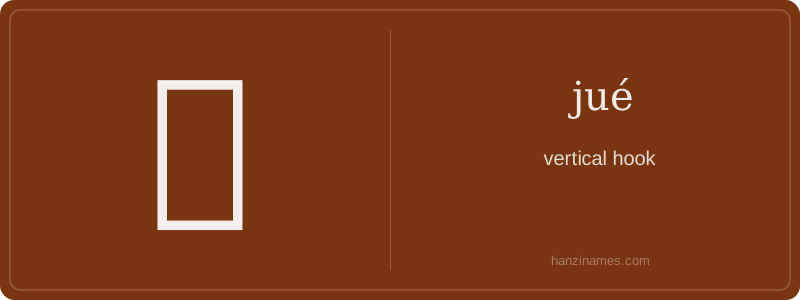
亅 does not appear independently in modern Mandarin words, idioms, or texts—it is exclusively a stroke name and dictionary radical. In daily life, Chinese teachers use it when instructing children on correct stroke order: 'First the horizontal, then the vertical hook (shùgōu)' while writing 小 or 手. Calligraphy manuals and standardized tests (e.g., China’s National Standard GB/T 16159–2012 for Chinese character strokes) formally define it as 'shùgōu', and it’s listed as Radical 5 in the Kangxi Dictionary—a classification still used in Unicode and digital input methods.
This character originated not as a pictograph but as a stylized stroke notation. Unlike ancient oracle-bone characters, 亅 was formalized during the Han dynasty (206 BCE–220 CE) as part of systematic stroke taxonomy. Its shape reflects the natural motion of the brush: pressing down vertically, then lifting with a hooked flick—mirroring ink-trail physics. Today, you’ll see it labeled on whiteboards in Shanghai elementary schools or highlighted in Baidu Baike stroke diagrams.
The character 亅 (jué) is not a standalone word in modern Chinese but a foundational stroke—specifically the 'vertical hook' (shùgōu), one of the eight essential brushstroke types in traditional calligraphy. It appears as a downward vertical line ending with a sharp, rightward hook, like a fishhook or a stylized anchor. This stroke is indispensable for writing characters such as 小 (xiǎo, 'small'), 水 (shuǐ, 'water'), and 永 (yǒng, 'eternity')—all taught early in stroke-order pedagogy.
Though rarely used alone, 亅 carries immense functional weight: it anchors balance in many characters and signals terminal emphasis in handwritten script. In calligraphy exams and HSK handwriting sections, mastering its precise angle, pressure taper, and hook curvature is critical. Its omission or misplacement can render a character illegible—even if all other strokes are correct—making it a subtle yet non-negotiable element of written Chinese literacy.
Unlike pictographic or ideographic characters, 亅 belongs to the category of 'stroke radicals'—a meta-level graphic unit codified in dictionaries like the Kangxi Dictionary (1716) under Radical 5. It’s classified not by meaning but by form and function, reflecting how Chinese orthography evolved to prioritize structural logic over semantic derivation. Today, learners encounter it first in stroke-order drills, not vocabulary lists—highlighting how Chinese writing is built from disciplined gesture, not just abstract symbols.
Example Sentences
Common Compounds
Similar Characters — Don't Mix These Up
Your First Step into Chinese Culture: Get a Chinese Name
Every journey into Chinese begins with a name. Use our free Chinese name generator to create a meaningful, personalized Chinese name that fits you perfectly.
Get My Chinese Name →