亠
Character Story & Explanation
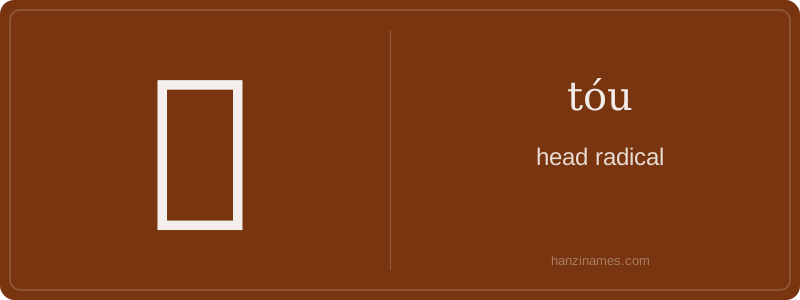
亠 has no independent usage in modern spoken or written Mandarin—it does not appear in dictionaries as a word, nor is it used in idioms, slogans, or daily communication. It exists solely as a dictionary radical and structural element. In historical texts, it appears only as part of larger characters; no classical text uses 亠 alone. Its role is purely orthographic: it helps categorize characters in traditional and modern Chinese dictionaries (e.g., Kangxi, Xinhua Zidian).
The form of 亠 likely evolved from the ancient pictograph for ‘roof’ (宀 mián), simplified over centuries for speed and consistency in clerical and regular script. Unlike 宀—which retains three strokes and clear roof symbolism—亠 is a highly abstracted, minimalist variant. Today, Chinese learners encounter it first when studying stroke order and radical identification—not as vocabulary, but as a key to unlocking character logic.
亠 (tóu) is not a standalone character used in modern Chinese writing, but rather a fundamental component known as a 'radical' or 'head radical'. It appears at the top of many characters—like 京 (jīng, capital), 亡 (wáng, to perish), and 亢 (kàng, high)—and historically conveys the idea of 'covering', 'overhead', or 'a lid-like structure'. Though it carries no independent meaning today, its presence signals semantic or phonetic relationships in compound characters.
This two-stroke radical consists of a dot (丶) followed by a horizontal stroke (一), forming a simple, balanced shape that visually suggests a roof or canopy. Its minimalism reflects classical Chinese calligraphic economy: conveying spatial hierarchy with minimal strokes. Unlike Western alphabetic letters, which represent sounds, 亠 functions purely as a structural and classificatory marker in the logographic system.
In Chinese lexicography, 亠 is listed as Radical 3 (in Kangxi Dictionary order) and serves as an organizational anchor in dictionaries. While learners may never write 亠 alone, recognizing it accelerates character decomposition and memorization. Its recurrence across hundreds of characters makes it a silent but essential scaffold—like architectural blueprints guiding how meaning and sound are layered in written Chinese.
Example Sentences
Common Compounds
Similar Characters — Don't Mix These Up
Your First Step into Chinese Culture: Get a Chinese Name
Every journey into Chinese begins with a name. Use our free Chinese name generator to create a meaningful, personalized Chinese name that fits you perfectly.
Get My Chinese Name →