亹
Character Story & Explanation
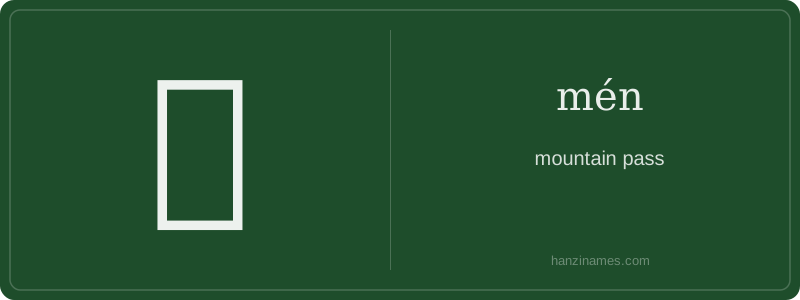
亹 is virtually absent from modern spoken Mandarin and daily writing. It appears almost exclusively in historical toponyms—most notably the ancient Wěi Pass (亹口) on the Hexi Corridor, a critical Silk Road chokepoint recorded in the *Book of Han* (c. 1st century CE). No idioms or colloquial phrases contain it; even native speakers rarely encounter it outside academic history or epigraphy.
The character’s structure is not pictographic but phono-semantic: the upper 亠 + two 彳 suggest ‘repeated passage’, while the lower 門 (mén, ‘gate’) provides both sound and semantic anchor—literally ‘mountain-gate’. Its earliest attestation is in seal script on Han-era bronze inscriptions, confirming its use as a toponymic marker for guarded mountain thresholds—not as a verb or abstract noun.
As an archaeologist brushing dust from a Tang-dynasty stele near the Qilian Mountains, I first encountered 亹 carved deeply into weathered granite—its 21 strokes echoing the jagged contours of a narrow alpine pass. The radical 亠 (tóu, 'lid') crowns the character like a rocky overhang, while the lower components—a doubled 彳 (chì, 'step') and 門 (mén, 'gate')—suggest guarded movement through a threshold in the mountains. This is not mere topography; it’s cartography encoded in calligraphy.
Lexicographic excavation reveals duality: mén reflects its geographic core meaning ('mountain pass'), while wěi appears in classical texts like the *Shuōwén Jiězì* as a rare variant tied to ‘diligence’ or ‘vigilance’—likely a phonosemantic borrowing where the same form acquired a moral nuance in Confucian commentary. Such semantic bifurcation is common in early Chinese script: terrain shapes ethics.
The character’s rarity today makes it a linguistic fossil. It survives not in textbooks but in place names and stone inscriptions—like Wěi River (亹水) in Gansu, documented since the Han dynasty. Its stroke complexity (21!) discouraged simplification; unlike most characters, 亹 was omitted from the 1956 *List of Simplified Characters*. Thus, it stands intact—a palimpsest of geography, governance, and grammatical evolution preserved in ink and rock.
Example Sentences
Common Compounds
Similar Characters — Don't Mix These Up
Your First Step into Chinese Culture: Get a Chinese Name
Every journey into Chinese begins with a name. Use our free Chinese name generator to create a meaningful, personalized Chinese name that fits you perfectly.
Get My Chinese Name →