仄
Character Story & Explanation
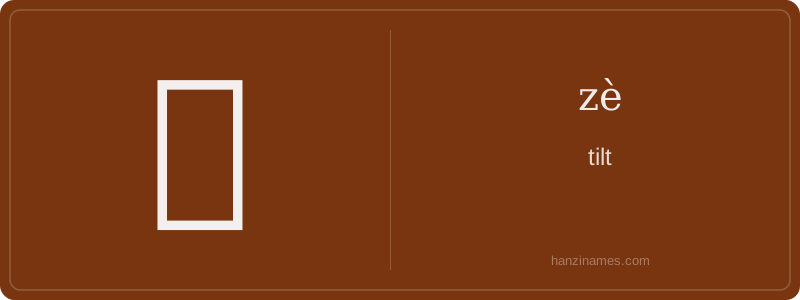
In contemporary China, 仄 is most commonly encountered in poetry classes, calligraphy workshops, and classical music theory — especially when teaching the rules of Tang dynasty regulated verse. It appears in phrases like ‘平仄格律’ (píng zè gélǜ), meaning 'tonal pattern and metrical rules', a cornerstone of traditional Chinese versification. The term is standard in HSK Advanced (Level 6) curricula and national high school literature exams. It also surfaces in modern idioms like ‘平仄有致’ (píng zè yǒu zhì), describing rhythmic elegance in speech or writing.
The character’s form is not pictographic but phono-semantic: the 人 (rén, 'person') radical hints at human articulation (i.e., tone production), while the right component (a variant of 厂, historically associated with slope or shelter) suggests inclination. Archaeological inscriptions confirm its use in Han dynasty phonological texts to classify tones — no oracle bone origins; its earliest verified usage is in Eastern Han rhyme dictionaries like the 《声类》 (c. 227 CE).
The character 仄 (zè) evokes a subtle but pervasive sense of imbalance — not dramatic collapse, but the quiet lean of a bamboo stalk in mountain wind, or the slight slant of afternoon light across an old Beijing courtyard. Its four strokes — a person radical (人) paired with a diagonal stroke suggesting deviation — visually embody asymmetry and controlled instability. In classical Chinese prosody, 仄 is one of two tonal categories (alongside 平, 'level'), governing poetic meter by marking syllables with falling, rising, or entering tones.
This tonal function is foundational to traditional poetry forms like regulated verse (律诗), where strict alternation between 平 and 仄 ensures rhythmic elegance and sonic balance. Though rarely used alone in modern speech, 仄 appears in literary, linguistic, and musical contexts — always signaling deviation from the norm, whether in pitch, posture, or structure. Its minimal form belies deep structural importance.
For learners, 仄 is a gateway into understanding how Chinese integrates sound, meaning, and writing. It’s not just 'tilt' as physical inclination, but 'tilt' as phonological contrast, aesthetic principle, and even philosophical nuance — echoing Daoist ideas of dynamic equilibrium, where tension and slant are necessary for harmony. Mastering 仄 means grasping that balance in Chinese culture often arises *through* measured imbalance, not its absence.
Example Sentences
Common Compounds
Similar Characters — Don't Mix These Up
Your First Step into Chinese Culture: Get a Chinese Name
Every journey into Chinese begins with a name. Use our free Chinese name generator to create a meaningful, personalized Chinese name that fits you perfectly.
Get My Chinese Name →