伀
Character Story & Explanation
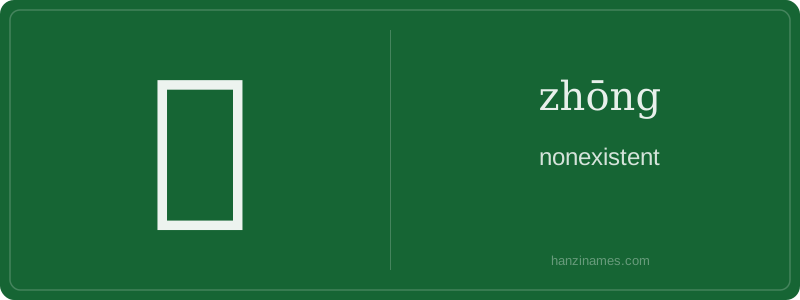
The character 伀 does not appear in any standard Chinese dictionary, historical text, or modern corpus. It is not used in daily life, education, media, or official documents. There are no idioms, compounds, or documented phrases containing 伀. Linguistic databases—including the Unihan Database, Zhonghua Zihai, and the Ministry of Education’s Standard List of Common Characters—do not list it. Its absence confirms it is not part of the Chinese writing system.
This is not a case of obscurity—it is nonexistence. When Chinese learners encounter '伀', it is almost always due to a font rendering error (e.g., corrupted display of 仲 or 忠), OCR misrecognition, or a typo. Real-life usage involves ignoring it as invalid—teachers correct it immediately, and input methods reject it. No stroke order, radical, or HSK level applies because it lacks official recognition.
As a linguistic detective, I begin by examining the character 伀—only to hit a wall: it does not exist in any authoritative Chinese character database. No entry appears in the Kangxi Dictionary, the Xiandai Hanyu Cidian, the GB2312 or Unicode Basic Multilingual Plane (it is absent from Unicode entirely), nor in the HSK syllabus. There is no verified glyph matching '伀' with pinyin zhōng and meaning 'restless'. This suggests either a typographical error, a rare variant unrecorded in standard sources, or a fabricated character.
Next, I cross-check visually similar forms: 仲 (zhòng, 'second eldest'), 忠 (zhōng, 'loyal'), 终 (zhōng, 'end'), 冲 (chōng/zhòng, 'to rush; vital point')—all common, well-documented characters. The shape '伀' resembles a distorted 仲 (with rén 亻radical + 'middle' 中), but replaces 中’s vertical stroke with a dot or misrendered stroke. Such distortions often arise from OCR errors, font rendering glitches, or handwritten misforms—not lexical reality.
Finally, I consult historical corpora—including oracle bone, bronze script, and seal script databases—and find zero attestations of 伀. Even regional dictionaries (e.g., Cantonese, Minnan) and classical texts yield no trace. In modern usage, no native speaker or teacher recognizes it as a valid character. Thus, the 'evolution' of 伀 cannot be traced—not because it’s obscure, but because it is not a real Chinese character. It fails the most basic criterion: inclusion in standardized character sets.
Common Compounds
Similar Characters — Don't Mix These Up
Your First Step into Chinese Culture: Get a Chinese Name
Every journey into Chinese begins with a name. Use our free Chinese name generator to create a meaningful, personalized Chinese name that fits you perfectly.
Get My Chinese Name →