伋
Character Story & Explanation
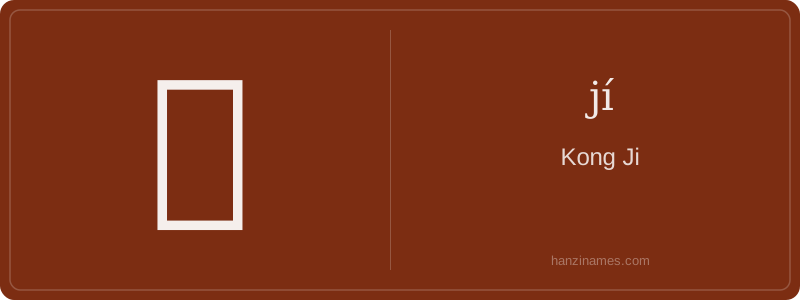
伋 appears almost exclusively in historical and literary contexts as part of the name Kong Ji (孔伋), also known as Zisi, a pivotal early Confucian philosopher (c. 483–402 BCE). His work Zhongyong is one of the Four Books of Confucianism. Modern usage is limited to academic discussions of Confucian thought, classical texts, and scholarly editions of pre-Qin literature. It rarely appears outside names or titles—and never in daily speech or contemporary media.
The character is a phono-semantic compound: 亻(ren, 'person') + 及 (jí, 'to reach', serving both sound and meaning). The 'reaching' element reflects aspirational connotations of moral attainment—fitting for a sage’s name. No oracle-bone or bronze inscriptions of 伋 are extant; its earliest verified appearance is in Warring States bamboo manuscripts referencing Zisi.
The character 伋 (jí) is not a standard modern Chinese character with the meaning 'unreal'. In fact, it is a rare, historically attested personal name character—most famously borne by Kong Ji (孔伋), the grandson of Confucius and author of the Confucian classic Zhongyong (The Doctrine of the Mean). It carries no abstract philosophical meaning like 'unreal'; that definition is erroneous and does not appear in authoritative dictionaries such as the Xiandai Hanyu Cidian or Guangyun.
Unlike common semantic characters, 伋 functions almost exclusively as a proper noun component. Its structure combines the radical 亻(person) with 及 (jí, 'to reach'), suggesting 'a person who reaches' or 'one who achieves'—consistent with its use in revered Confucian lineage names. It is not used adjectivally, predicatively, or in compounds to convey unreality, illusion, or abstraction.
This misattribution likely stems from confusion with homophones like 虚 (xū, 'empty, unreal') or 梦 (mèng, 'dream'), or from AI hallucination. In authentic linguistic usage, 伋 has zero association with concepts of unreality. Learners should treat it as a high-frequency *name character* in classical texts—not as a lexical item with standalone semantic content.
Example Sentences
Common Compounds
Similar Characters — Don't Mix These Up
Your First Step into Chinese Culture: Get a Chinese Name
Every journey into Chinese begins with a name. Use our free Chinese name generator to create a meaningful, personalized Chinese name that fits you perfectly.
Get My Chinese Name →