佃
Character Story & Explanation
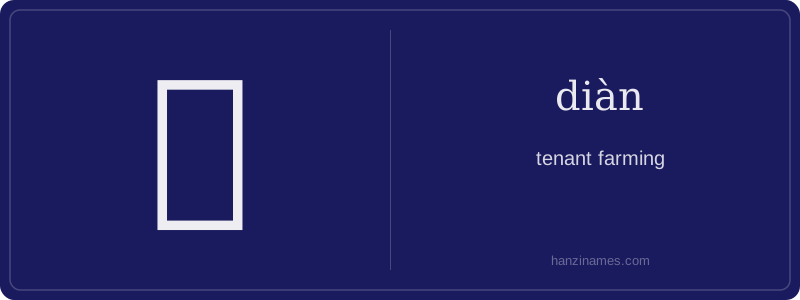
In imperial China, 佃 denoted the legally recognized tenant farmer—a cornerstone of the ‘landlord-tenant’ system documented in Song, Ming, and Qing legal codes and tax records. Though rare in modern spoken Mandarin, it survives in historical discourse, academic writing on agrarian history, and terms like 佃户 (diànhù, ‘tenant household’). No common idioms feature 佃 today; its usage is almost exclusively technical or archival.
The character is not pictographic but phono-semantic: 亻 (person) + 田 (field, both semantic and phonetic component). 田 originally depicted a bounded agricultural plot (oracle bone script: ⬛ with cross-hatching). In 佃, 田 provides both meaning (land) and approximate sound (Old Chinese *den ~ *tʰen), while 亻 specifies human agency—making it a classic ‘person + field’ compound for ‘one who works rented land’.
As an archaeologist sifting through layers of linguistic sediment, I find 佃 not etched on oracle bones but emerging clearly in Han dynasty administrative texts—where land tenure systems crystallized. Its early form reveals a human radical (亻) paired with 田 (field), signaling not mere labor, but a socially codified relationship: one person standing *beside* cultivated land under contractual obligation. This wasn’t subsistence farming—it was the juridical heart of imperial agrarian economy.
The dual pronunciation diàn/tián whispers of historical phonetic drift and dialectal survival. While diàn dominates in formal and historical usage (e.g., ‘tenant farmer’), tián appears in rare regional variants and archaic compounds, hinting at Old Chinese *l̥-den or similar roots tied to land management. The character’s stability across 2,000 years—unchanged in seal, clerical, and standard script—testifies to its institutional weight: it named a role as fixed as the tax registers it populated.
Beneath its modest seven strokes lies a microcosm of pre-modern Chinese society: hierarchy inscribed in ink. The 亻 radical positions humanity not as master of nature, but as intermediary—bound to soil by lease, not birthright. When excavating Ming dynasty land deeds from Shanxi archives, I’ve seen 佃 repeated like a refrain beside names, dates, and grain quotas. It is less a verb than a social fingerprint: evidence of who tilled, who owned, and how power rooted itself in furrows.
Example Sentences
Common Compounds
Similar Characters — Don't Mix These Up
Your First Step into Chinese Culture: Get a Chinese Name
Every journey into Chinese begins with a name. Use our free Chinese name generator to create a meaningful, personalized Chinese name that fits you perfectly.
Get My Chinese Name →